 Shadow
 The Cities Where Bicycles Outnumber Cars on the Commute
Copenhagen leads global cities with 49% of all trips to work or education made by bicycle, significantly outpacing car commutes. This analysis reveals top cycling cities worldwide.
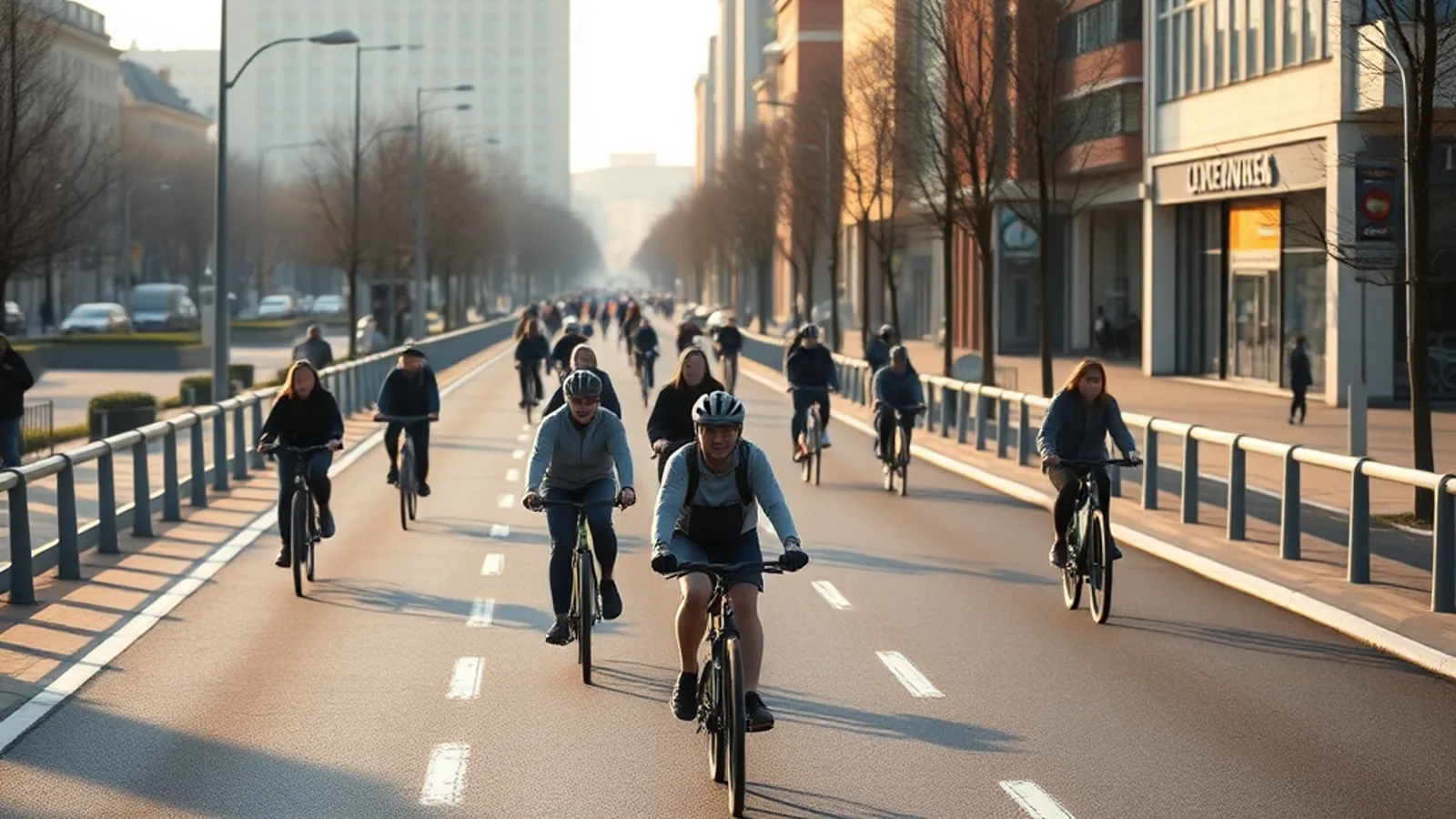
Copenhagen stands out as a global leader where bicycles significantly outnumber cars on the commute. According to the City of Copenhagen's Bicycle Account, 49% of all trips to work or education are made by bicycle, a substantial increase from 35% a decade prior. This makes cycling the dominant mode of transport for residents.
Global Cities Leading the Cycling Revolution
Copenhagen's commitment to cycling is evident in its infrastructure and usage statistics. The city now boasts approximately 675,000 bicycles for a population of around 650,000, meaning there are more bikes than people. For residents living within the city itself, 62% of trips to work or education are made by bicycle, compared to only 9% by car. Since 2016, bicycles have consistently outnumbered cars in daily traffic counts within Copenhagen's inner core.
Beyond Denmark, other European cities demonstrate similar cycling dominance. Utrecht, in the Netherlands, leads with 51% of all trips made by bicycle. Amsterdam follows closely at 48%, with more than double the number of trips cycled compared to those driven by private car. Utrecht's city center alone attracts 125,000 cyclists on an average day, representing over a third of the city's entire population. Across all four of the Netherlands' largest cities, bicycles account for roughly 40% of every trip not made on foot.
China has also seen a remarkable cycling resurgence. In the 1980s, bicycles accounted for 63% of all journeys in Beijing. This figure plummeted to 17.8% by 2014 due to increased car ownership. However, shared bicycle programs have reversed this trend; by November 2023, Beijing's bike-share systems recorded over 1 billion rides in a single year, averaging 3.12 million rides daily. In Guangzhou, e-bikes alone now handle an estimated 6 million trips a day, a volume comparable to the city's entire subway system. Notably, China's cycling comeback was driven primarily by private bike-share apps, a contrast to Europe's infrastructure-led growth.
America's Small-City Cycling Champions
The United States presents a different picture, with no large city approaching the cycling rates seen in Europe or China. According to the 2019 American Community Survey, the top US cities for bicycle commuting are smaller, often built around universities or compact, walkable cores.
The leading US cities for bicycle commuters include:
- Davis, California: 17.48% of commuters biking to work
- Key West, Florida: 15.29% of commuters biking to work
- Corvallis, Oregon: 11.10% of commuters biking to work
Among larger US cities, Portland, Oregon, leads with just 5.99% of commuters on bikes, a fraction of Copenhagen's citywide figure. Even America's top cycling city, Davis, falls short of what Copenhagen and Utrecht count as an ordinary neighborhood average, highlighting a significant gap in cycling adoption.
The Economic and Health Benefits of Cycling
The advantages of high bicycle commuting rates extend far beyond traffic management, encompassing substantial health and economic benefits. A study focused on the Minneapolis–St. Paul metro area found that bicycle commuting prevents between 12 and 61 deaths annually, saving an estimated $100 million to $500 million each year in avoided health costs.
Individual health improvements are also significant. Cyclists who incorporated three additional bike trips per week showed:
- 46% lower odds of metabolic syndrome
- 32% lower odds of obesity
- 28% lower odds of hypertension
On a broader scale, a 2011 University of Wisconsin study estimated that shifting half of all short car trips to bicycles across the upper Midwest's largest metro areas could save $3.8 billion annually and prevent more than 1,000 deaths. These health savings often dwarf the initial investment required for the bicycle infrastructure that makes such commuting possible.
Investing in Bicycle Infrastructure
High bicycle commuting rates are not accidental; they are the result of deliberate, sustained investment in infrastructure. The 2022 Global Bicycle Cities Index, which evaluated 90 cities worldwide, found that nine of the top ten cycling cities were in Europe. Hangzhou, China, was the sole non-European city to break into this top tier, reflecting China's own efforts in cycling infrastructure.
Antwerp, Belgium, demonstrated one of the sharpest gains among European contenders, increasing its bicycle mode share from 29% to 33% between 2014 and 2018. In contrast, not a single US city ranked in the top 30 of the same index, with San Francisco being the highest American entry at 39th place.
Copenhagen's success is a direct outcome of decades of strategic planning. Since 2004, the city has invested over 2 billion Danish kroner in bicycle-specific infrastructure, including bridges built exclusively for bikes, dedicated cycle superhighways, and continuous snow-clearing during winter months. The city's cycle superhighway network connects to 28 surrounding municipalities across more than 500 planned kilometers, designed to attract longer-distance commuters.
Copenhagen residents themselves explain their preference for cycling:
- 55% state it is simply easier than alternative transport options.
- 46% find it faster than driving or taking public transit.
The consistent takeaway from cities with genuinely high bicycle commuting rates is that success comes from making cycling measurably faster and more convenient than any other transportation option, rather than solely discouraging car use.
Key takeaways
- Copenhagen leads globally with 49% of commutes by bike, reaching 62% in its inner core, and boasts more bicycles than people.
- Dutch cities Utrecht (51%) and Amsterdam (48%) also show high cycling rates, with Utrecht's city center seeing 125,000 daily cyclists.
- China's cycling resurgence, particularly in Beijing and Guangzhou, is largely driven by private bike-share apps, contrasting with Europe's infrastructure-led growth.
- In the US, small cities like Davis, California (17.48%), Key West, Florida (15.29%), and Corvallis, Oregon (11.10%) lead, while large cities lag significantly.
- High cycling rates yield substantial health and economic benefits, with studies estimating billions in savings from avoided healthcare costs and prevented deaths.
- Successful cycling cities achieve high adoption by making biking faster and more convenient through dedicated infrastructure and sustained investment.
This article provides general information and statistics for informational purposes only. It is not intended as legal, financial, or tax advice. Always consult with qualified professionals for specific guidance.
Compare jurisdictions with TERRA AI
Statistics about where people live are only half the decision. If you are building an online business or choosing tax residency deliberately, TERRA AI compares Stacks by tax treatment, regulatory burden, sovereignty, and values — then connects you with licensed attorneys and advisors who execute.
This article is general information only and is not legal or tax advice. Consult a licensed professional in your jurisdiction before acting on residency, incorporation, or tax topics.