 Shadow
 Cities With the Most Green Roofs
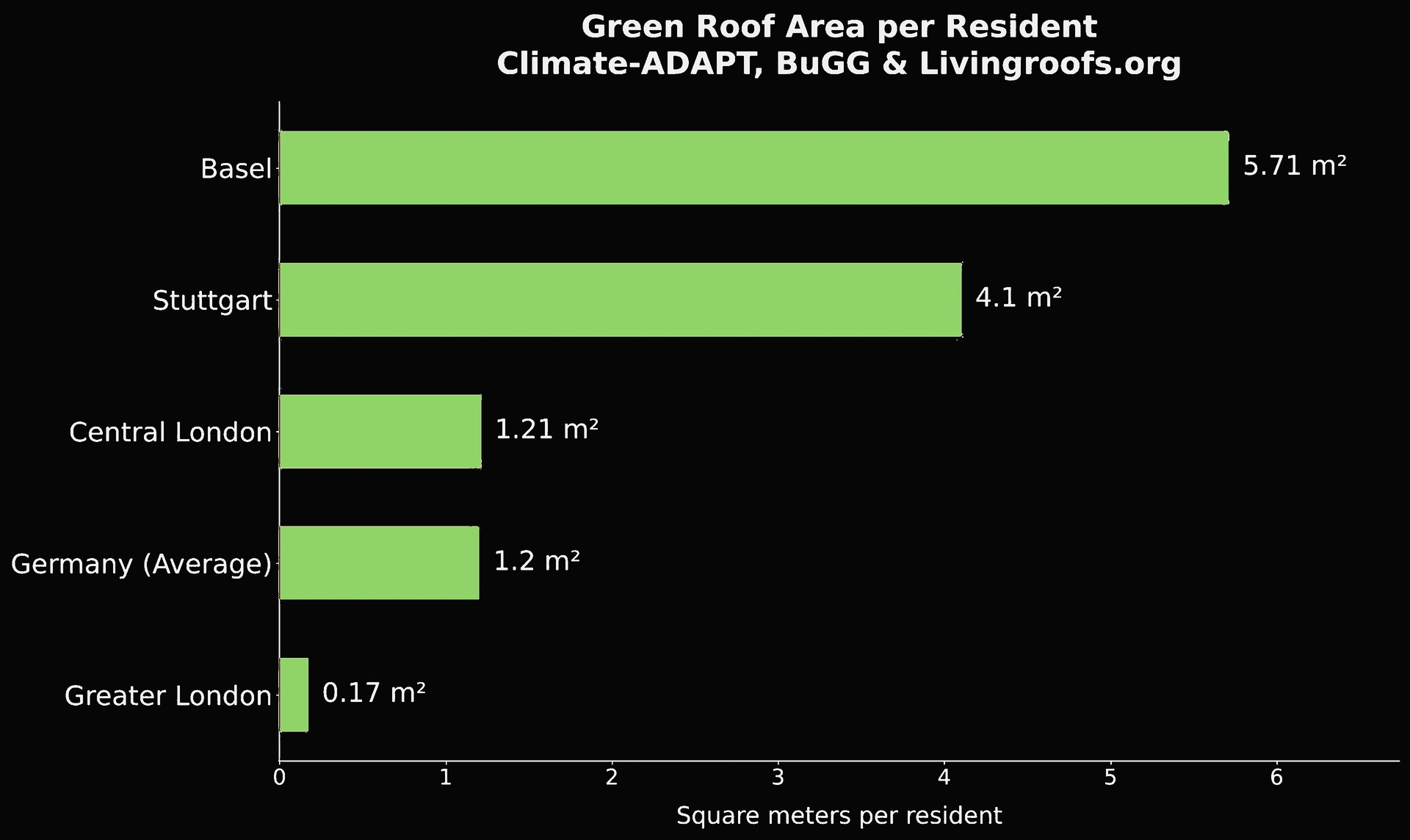
Basel, Switzerland, leads globally with 5.71 square meters of green roof per resident. Germany boasts 120 million square meters of total green roof area, while London has 1.5 million square meters.
Basel, Switzerland, stands as the global leader in green roof adoption, boasting approximately 5.71 square meters of green roof for every resident. This commitment to urban greening transforms city skylines from gray to living landscapes, offering environmental benefits like cooling buildings and managing stormwater.
Basel: The Global Leader in Green Roofs
Basel, a mid-sized Swiss city, leads the world in green roof density. The city has approximately 5.71 square meters of green roof for every resident, a figure unmatched globally. Since 2006, Basel has consistently added around 80,000 square meters of green roofs annually.
In 2006, about 23% of Basel’s flat roofs were green. Today, this figure is estimated to be close to 40%. This growth is largely due to a building law enacted in 2002, which mandates that all new flat roofs must incorporate greening. Basel's per-person green roof area significantly surpasses other nations, demonstrating a focused urban planning strategy.
Germany's Extensive Green Roof Movement
Germany has widely adopted green roofs, with many of its cities competing for the top spot in national rankings. The country added approximately 7.2 million square meters of green roofs in 2019 alone, bringing its total estimated green roof area to around 120 million square meters. Despite this extensive adoption, only about 9% of new flat roofs built in 2019 were greened, indicating potential for further expansion.
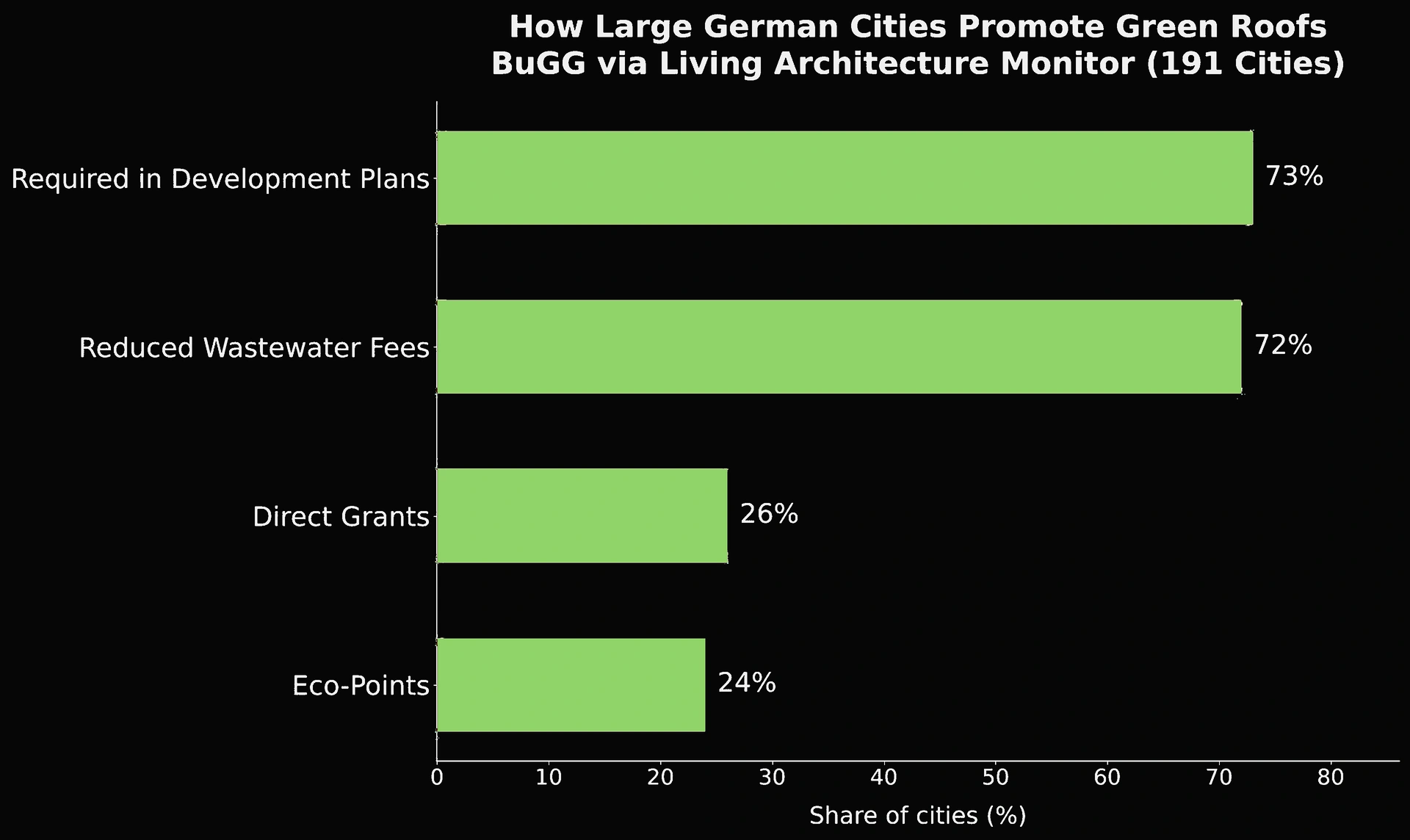
German cities are at the forefront of this movement, with 73% of large cities requiring green roofs in some development plans. Additionally, 72% of these cities offer reduced wastewater fees for buildings with green roofs, providing a financial incentive for property owners.
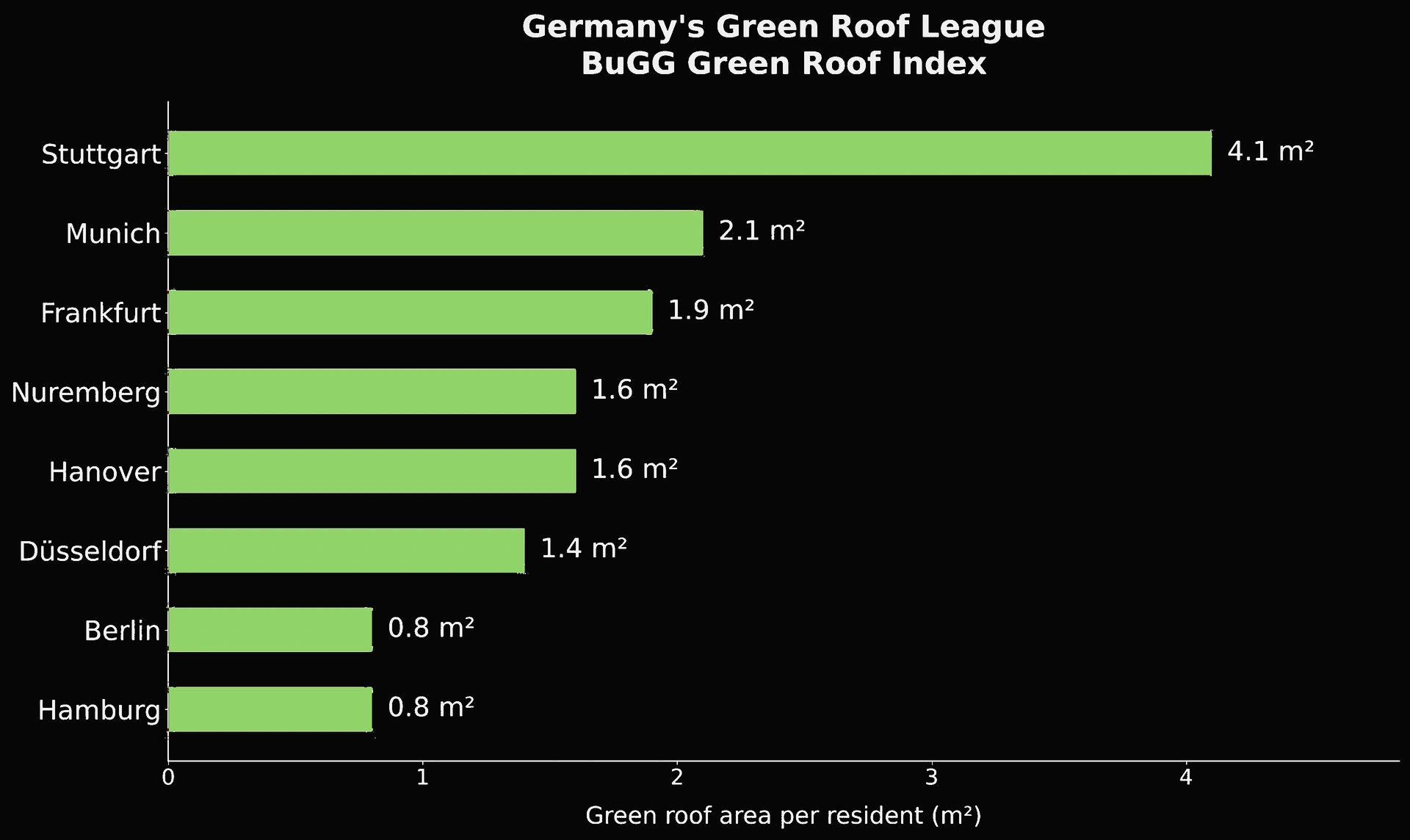
- Stuttgart: 4.1 square meters per resident
- Munich: 2.1 square meters per resident (and largest total area at 3.1 million square meters)
- Frankfurt: 1.9 square meters per resident
- Nuremberg: 1.6 square meters per resident
- Hanover: 1.6 square meters per resident
- Düsseldorf: 1.4 square meters per resident
- Berlin and Hamburg: 0.8 square meters per resident
Munich, while not leading in per-resident area, boasts the largest total green roof area among German cities, exceeding 3.1 million square meters. Stuttgart, however, has five times as much green roof space per resident compared to Germany's capital, Berlin.
Major Cities Embracing Sky Gardens
Beyond Switzerland and Germany, several major global cities have made significant strides in integrating green roofs and skyrise greenery into their urban fabric.
London's Concentrated Green Network
Greater London has developed one of the largest green roof networks among major cities, totaling approximately 1.5 million square meters. Across the entire city, this equates to 0.17 square meters per resident. However, in the dense Central Activities Zone, this figure rises sharply to 1.21 square meters per resident, more than seven times the citywide average. London first incorporated green roofs into its city planning regulations in 2008, focusing on areas where ground-level green space is most limited.
Toronto's Pioneering North American Effort
For years, Toronto was a pioneer in North America for green roof initiatives. In 2009, it became the first city on the continent to mandate green roofs on many new buildings. By 2017, approximately 450,000 square meters of green roofs had been permitted, and by 2024, over 1 million square meters had been installed since 2010, accounting for more than 1,000 green roofs across the city. However, in 2025, Ontario’s provincial government repealed this requirement, citing a need to accelerate housing construction. This decision reversed 15 years of policy that had led to substantial green infrastructure development.
Singapore's "City in Nature" Vision
Tropical Singapore integrates greenery not just on rooftops but also vertically on building walls. The city-state boasts about 193 hectares of skyrise greenery—equivalent to roughly 1.93 million square meters. Overall, more than 40% of Singapore is covered in greenery. The government has also established over 380 kilometers of park connectors, linking various green spaces. This extensive greening is a core component of Singapore's "City in Nature" vision, with its sky gardens covering more area than London's total green roof network.
Policy as a Catalyst for Green Infrastructure
The success stories of cities with extensive green roofs are rarely accidental; they are typically driven by deliberate policy decisions and incentives.
- Mandatory Requirements: Basel (since 2002), Copenhagen (since 2010), and San Francisco (15–30% roof space for green roofs/solar) have implemented mandatory green roof policies for new constructions or public buildings. Toronto also had a bylaw requiring 20% to 60% green roof space until its repeal.
- Financial Incentives: Portland offers $5 per square foot for eco-roofs, while Hamburg has provided subsidies of up to €100,000. Many German cities offer reduced wastewater fees to buildings with green roofs, lowering water bills and providing a powerful incentive.
These policy frameworks demonstrate that urban greening initiatives thrive when integrated into building codes and supported by financial encouragement. Cities that have made green roofs a rule, rather than an option, have seen the most significant transformation of their skylines.
Key takeaways
- Basel, Switzerland, leads globally with 5.71 square meters of green roof per resident, driven by a 2002 mandate for new flat roofs.
- Germany has an estimated 120 million square meters of total green roof area, with cities like Stuttgart and Munich leading national efforts and offering incentives like reduced wastewater fees.
- Major cities like London, Toronto, and Singapore have implemented significant green roof programs, often concentrating greenery in dense urban cores or integrating it into broader "City in Nature" visions.
- Policy and financial incentives are critical drivers for green roof adoption, including mandatory building codes, subsidies, and reduced utility costs.
- While some cities, like Toronto, have seen policy reversals, the overall trend among leading urban centers is towards integrating green infrastructure as a standard practice.
This article provides general information and statistics about urban green infrastructure. It is not intended as legal, financial, or architectural advice. Readers should consult with qualified professionals for specific guidance related to building codes, environmental regulations, or urban development projects.
Compare jurisdictions with TERRA AI
Statistics about where people live are only half the decision. If you are building an online business or choosing tax residency deliberately, TERRA AI compares Stacks by tax treatment, regulatory burden, sovereignty, and values — then connects you with licensed attorneys and advisors who execute.
This article is general information only and is not legal or tax advice. Consult a licensed professional in your jurisdiction before acting on residency, incorporation, or tax topics.