 Shadow
 Countries Eating the Most Seafood
Iceland leads global seafood consumption at 83.81 kilograms per person, while Asia accounts for 70% of the world's aquatic animal production.

Iceland leads the world in per-person seafood consumption, with its citizens consuming an average of 83.81 kilograms annually. This figure highlights a global trend where island nations and coastal territories often exhibit the highest appetites for aquatic foods, a pattern influenced by geography and cultural heritage.
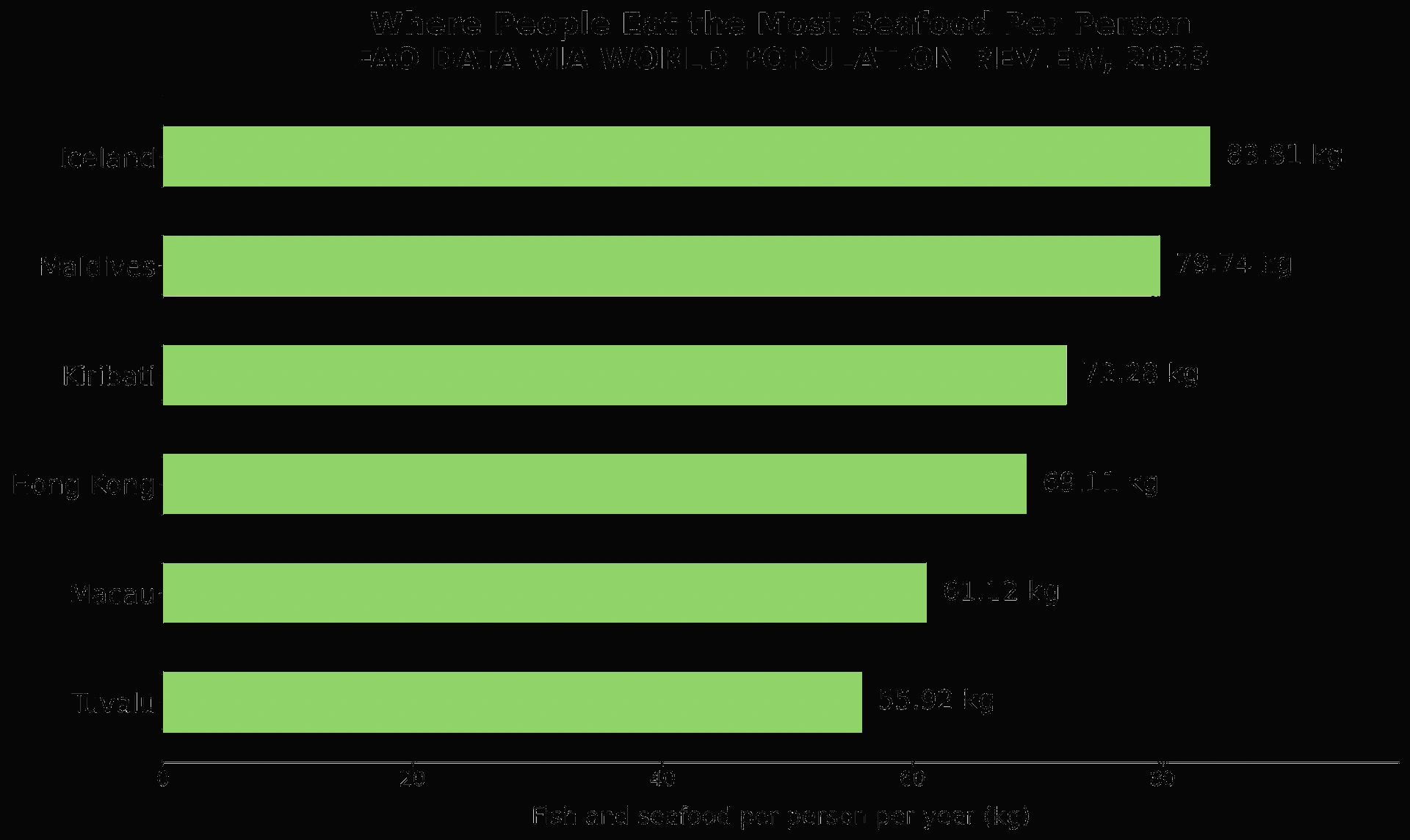
Nations with the Highest Seafood Appetite
While total volume is often dominated by populous nations, per-person seafood consumption reveals a different set of leaders. Small island and coastal territories consistently rank highest, driven by their proximity to marine resources and deeply ingrained culinary traditions.
According to FAO data compiled by World Population Review, Iceland stands out with an average of 83.81 kilograms of seafood consumed per person in 2023. The Maldives follows closely at 79.74 kilograms, demonstrating a similar reliance on the ocean's bounty.
Other top consumers include:
- Kiribati: 72.28 kilograms per person
- Hong Kong: 69.11 kilograms per person
- Macau: 61.12 kilograms per person
- Tuvalu: 55.92 kilograms per person
Even Tuvalu, ranking sixth, consumes over a kilogram of seafood per person weekly. This contrasts sharply with landlocked nations like Afghanistan, where per-person consumption is a mere 0.38 kilograms annually.
When focusing specifically on freshwater fish, the leaders shift. Myanmar consumes the most freshwater fish per person at 33.42 kilograms, ahead of Cambodia at 30.61 kilograms. However, in terms of total volume, China's vast population drives its consumption to 60,559 kilotonnes annually, more than four times India's 12,554 kilotonnes.
Global Seafood Consumption Has More Than Doubled
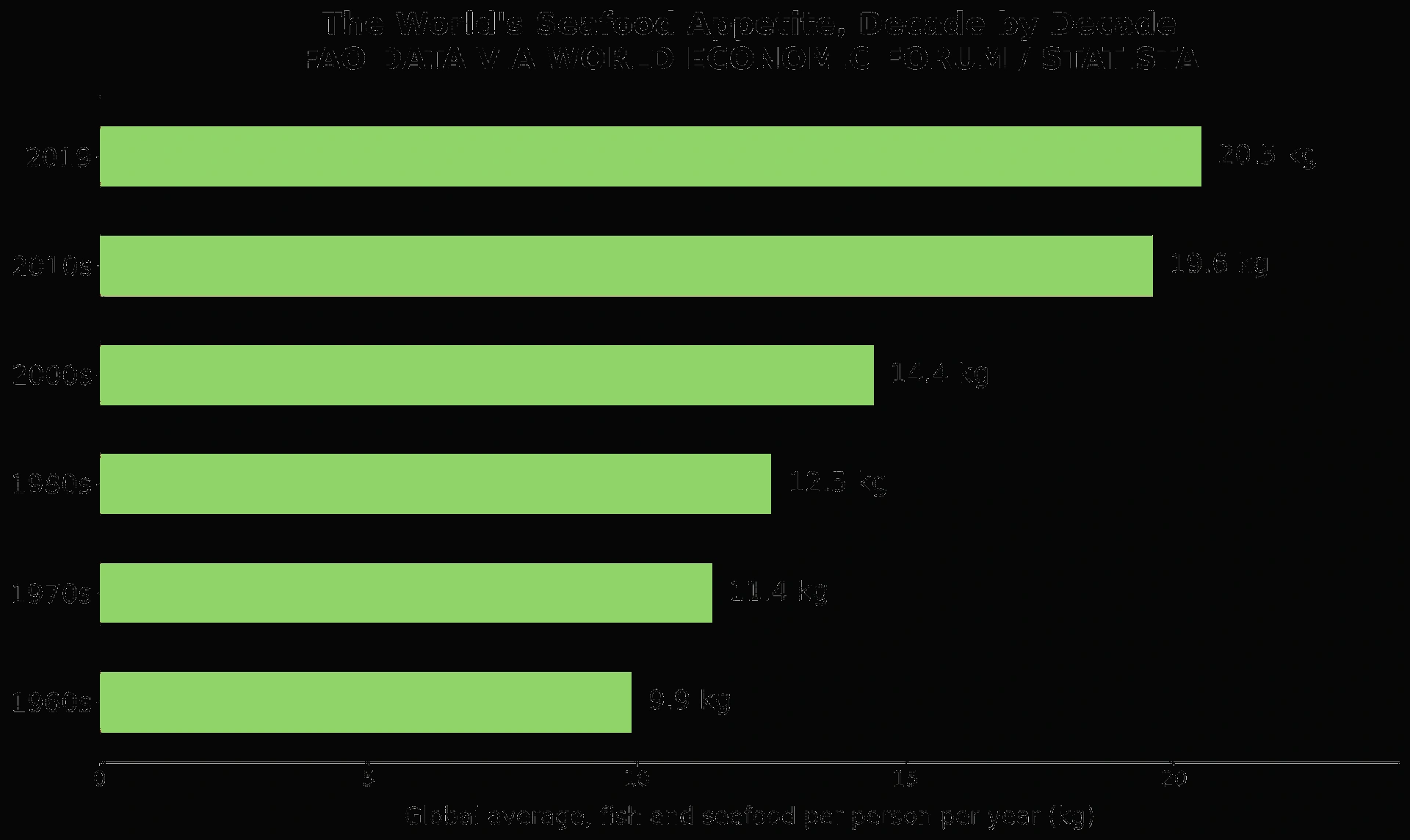
Beyond individual country rankings, the global trend in seafood consumption shows a significant increase over recent decades. The average worldwide consumption has more than doubled since the 1960s, reflecting shifts in dietary preferences, availability, and production methods.
Global average seafood consumption per person has steadily climbed:
- 1960s: 9.9 kilograms
- 1970s: 11.4 kilograms
- 1980s: 12.5 kilograms
- 2000s: 14.4 kilograms
- 2010s: 19.6 kilograms
- 2019: A record 20.5 kilograms
This upward trajectory highlights a growing global appetite for aquatic foods. The disparity remains stark, with coastal nations like Iceland and the Maldives consuming over 80 kilograms per person, while landlocked countries such as Afghanistan, Ethiopia, and Tajikistan consume less than 1 kilogram.
A significant factor enabling this increased consumption is the rise of aquaculture. Farmed fish accounted for nearly half of the world's aquatic animal production in 2020, playing a crucial role in meeting demand.
Asia Dominates Aquatic Animal Production
The production side of the global seafood industry is overwhelmingly concentrated in Asia. This region's extensive coastlines, advanced aquaculture practices, and large fishing fleets contribute to its leading position.
In 2022, Asia was responsible for 70% of the world's aquatic animal production. Other regions contributed significantly smaller shares:
- Europe: 9%
- Latin America: 9%
- Africa: 7%
- North America: 3%
- Oceania: 1%
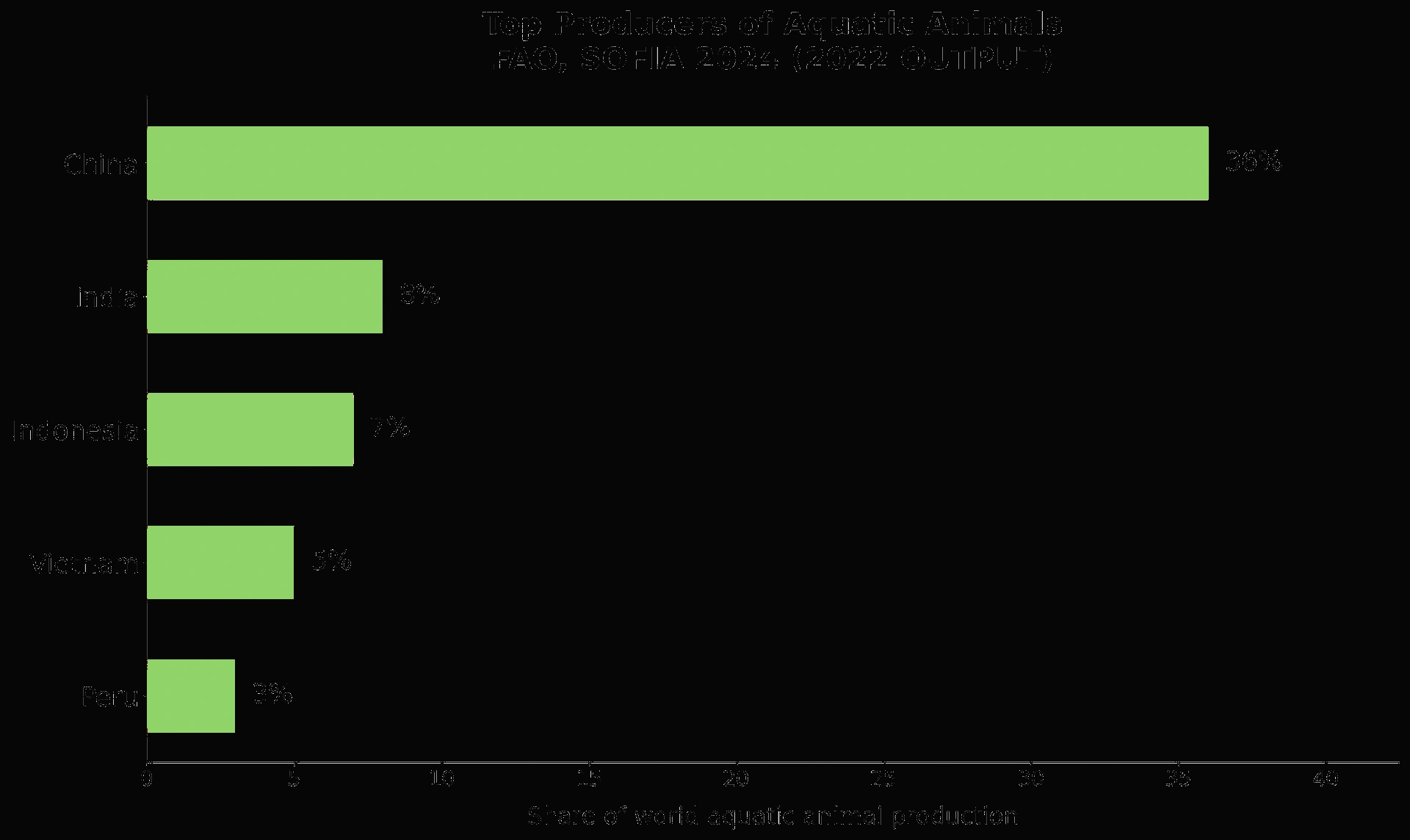
Within Asia, a few countries stand out as major producers. China alone produces 36% of the world's volume, followed by India at 8%, Indonesia at 7%, Vietnam at 5%, and Peru at 3%. These nations are critical to the global seafood supply chain.
Seafood provides approximately 15% of the world's animal protein, a figure that rises to over 50% in several countries across Asia and Africa. Globally, some 61.8 million people are employed in primary fishing and aquaculture. It is worth noting that the top seafood importers—the United States, China, Japan, Spain, and France—are not necessarily the top producers, indicating a substantial international trade in aquatic products.
Aquaculture Now Exceeds Wild Capture
A significant shift in how the world sources its seafood occurred in 2022. For the first time in history, aquaculture surpassed capture fisheries as the primary producer of aquatic animals. This milestone underscores the growing importance of farmed seafood in meeting global demand.
In 2022, aquaculture production reached 94.4 million tonnes, accounting for 51% of the total aquatic animal supply. This shift highlights a trend towards more controlled and intensive production methods. Aquaculture is also highly concentrated, with just ten countries producing over 89.8% of the world's farmed aquatic animals. These include China, Indonesia, India, Viet Nam, Bangladesh, the Philippines, South Korea, Norway, Egypt, and Chile.
Of all aquatic animal production, 89% is destined directly for human consumption. The remaining portion is primarily processed into fishmeal and fish oil, used in various industries including animal feed.
Africa Consumes the Least, Relies on it Most
Despite the global increase in seafood consumption, not all regions share equally in this abundance. Africa's average per-person consumption stands at 9.4 kilograms, less than half the world's average of 20.7 kilograms. This makes Africa the region with the lowest seafood consumption per person.
However, aquatic foods play a disproportionately vital role in Africa's diet. They supply 18% of Africa's animal protein, a figure above the global average of 15%. The FAO projects that Africa's per-person consumption may decline further as production struggles to keep pace with rapid population growth. To reach today's global average, Africa's seafood supply would need to increase by an estimated 285% by 2050.
A positive development in the region is the rapid growth of aquaculture, which has increased by 455% since 2000—the fastest growth worldwide. Egypt accounts for 62% of Africa's farmed output, with Nigeria contributing approximately 10%.
Shifting Seafood Habits in Europe and Japan
Even in regions with strong historical ties to seafood, consumption patterns are evolving. Portugal, traditionally the EU's biggest consumer, recorded 53.61 kilograms per person in 2023, a decrease from around 61 kilograms in 2018. The overall EU average also fell to 22.89 kilograms in 2023, its lowest since 2014, comprising 16.36 kilograms of wild-caught and 6.53 kilograms of farmed seafood.
Within the EU, countries like Hungary and Czechia consume less than 6 kilograms per person, highlighting significant internal disparities. For processed seafood alone, Spain leads at just over 8 kilograms per person, followed by Sweden at almost 8 kilograms and Germany at just under 7.5 kilograms.
Japan, a nation renowned for its seafood culture, has also seen a decline in consumption. Its annual per-person seafood consumption peaked at 40.2 kilograms in 2001 but now stands at an estimated 21.4 kilograms—nearly half its peak. Japan's self-sufficiency in edible seafood has fallen to about 54% in fiscal 2023, a stark contrast to its peak of 113% in fiscal 1964.
In 2024, Japan imported 2.2 million tonnes of seafood, primarily from suppliers in China, Chile, and the United States, with salmon and trout, shrimp, and bonito and tuna being the top products. Concurrently, the combined catch of Pacific saury, Japanese common squid, and salmon plummeted by around 80%, from 548,000 tonnes in 2014 to 107,000 tonnes in 2023. It is important to note that Japan's official figures count edible weight, which is not directly comparable to the live-weight rankings used for other countries.
Key takeaways
- Iceland leads global per-person seafood consumption at 83.81 kilograms, followed by other island nations like the Maldives and Kiribati.
- Global average seafood consumption has more than doubled since the 1960s, reaching 20.5 kilograms per person in 2019.
- Asia dominates aquatic animal production, accounting for 70% of the world's total, with China alone producing 36%.
- Aquaculture surpassed capture fisheries in 2022, supplying 51% of the world's aquatic animals, with production highly concentrated in ten countries.
- Africa has the lowest per-person consumption (9.4 kg) but relies on aquatic foods for 18% of its animal protein, above the global average.
- Traditional seafood-consuming nations like Portugal and Japan have seen significant declines in per-person consumption and self-sufficiency.
Disclaimer: This article provides general information based on World Population Review data and is not intended as financial, legal, or dietary advice. Consumption figures are based on apparent supply per person in live weight.
Compare jurisdictions with TERRA AI
Statistics about where people live are only half the decision. If you are building an online business or choosing tax residency deliberately, TERRA AI compares Stacks by tax treatment, regulatory burden, sovereignty, and values — then connects you with licensed attorneys and advisors who execute.
This article is general information only and is not legal or tax advice. Consult a licensed professional in your jurisdiction before acting on residency, incorporation, or tax topics.