 Shadow
 The World's Most Expensive Countries to Live In
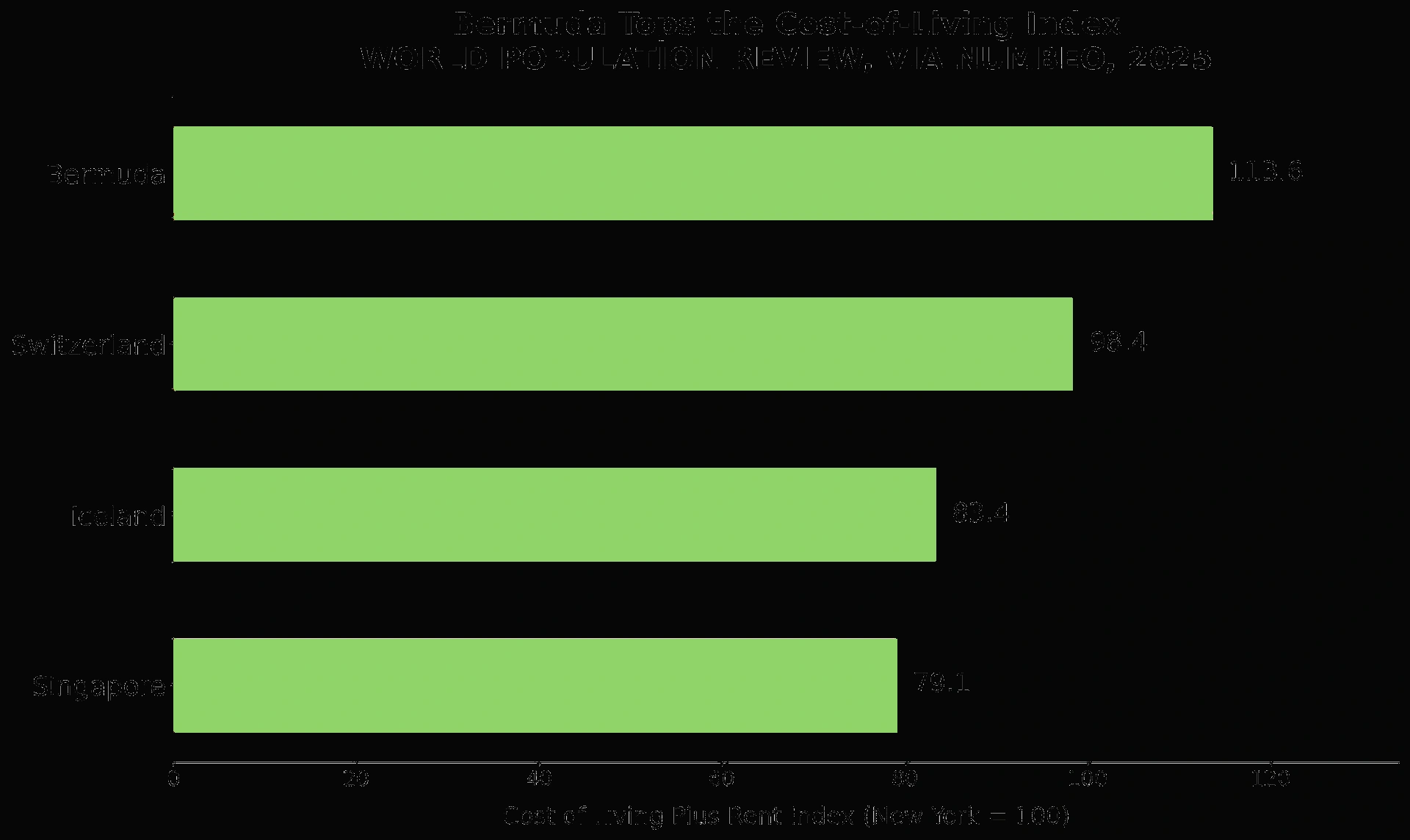
Bermuda leads global cost of living rankings with a Numbeo score of 113.6, while Switzerland dominates city-level lists with six of the top ten priciest cities.

While many assume major global capitals lead in living costs, World Population Review data reveals that Bermuda ranks as the single most expensive country on Earth, with a Numbeo Cost of Living Plus Rent score of 113.6. This places it significantly above Switzerland's 98.4 and the United States' 64.9, driven by factors like its island geography and status as a tax shelter.
Unexpected Leaders in Global Living Costs
World Population Review's analysis, based on Numbeo country data, identifies Bermuda as the world's most expensive place to live. Its capital, Hamilton, exemplifies this, with a 900-square-foot apartment typically renting for $4,058 per month. This high cost is characteristic of small island nations and tax shelters, a pattern also seen with the US Virgin Islands and the Cayman Islands, which rank similarly high in cost-of-living indexes.
These territories often share common traits:
- Limited land supply, driving up real estate costs.
- High dependence on imports for goods and services.
- Status as financial centers or tax havens, attracting high-net-worth individuals.
While these countries lead in overall cost, other rankings focus on cities, revealing different patterns of expense concentration.
Switzerland's Concentration of High-Cost Cities
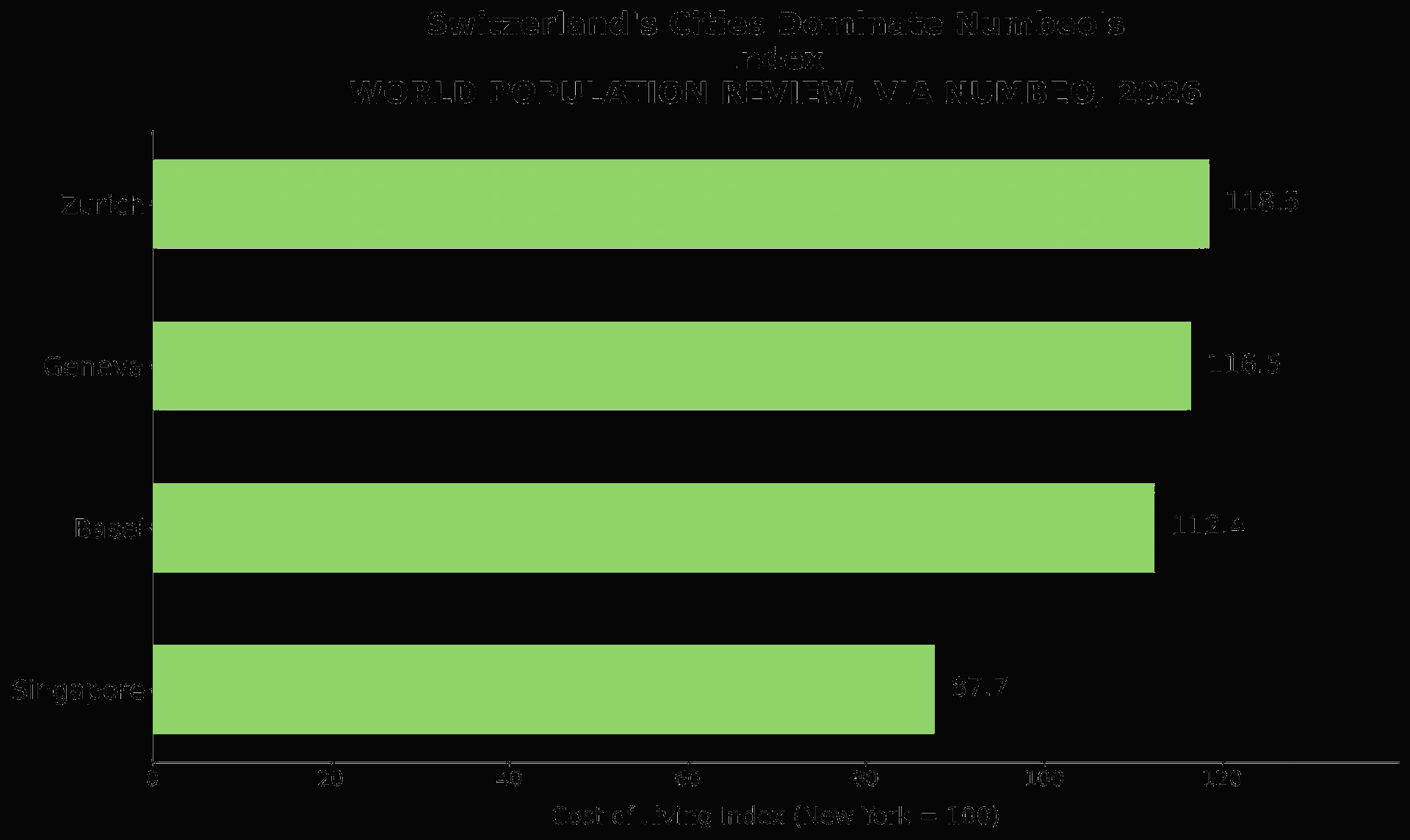
When examining city-level rankings, Switzerland consistently features at the top. Numbeo's 2026 city index places Zurich first with a score of 118.5, closely followed by Geneva at 116.5. Switzerland's dominance is pronounced, with six of the world's ten priciest cities on this measure:
- Zurich (118.5)
- Geneva (116.5)
- Basel
- Lausanne
- Lugano
- Bern
This concentration of high-cost cities is partly due to Switzerland's elevated food prices, which are the highest in the European Union. In contrast, Singapore, often cited as an expensive city, scores 87.7 on the same Numbeo list, making it cheaper than Reykjavik, Honolulu, and San Francisco by this specific metric.
Why Cost of Living Rankings Diverge
The apparent discrepancies between different cost-of-living indexes, such as Numbeo and the Economist Intelligence Unit (EIU), are not errors but reflections of their distinct methodologies. Numbeo gathers continuous, crowdsourced price data from residents globally. The EIU, conversely, dispatches researchers twice a year to survey approximately 400 specific prices across over 160 products and services in more than 160 cities.
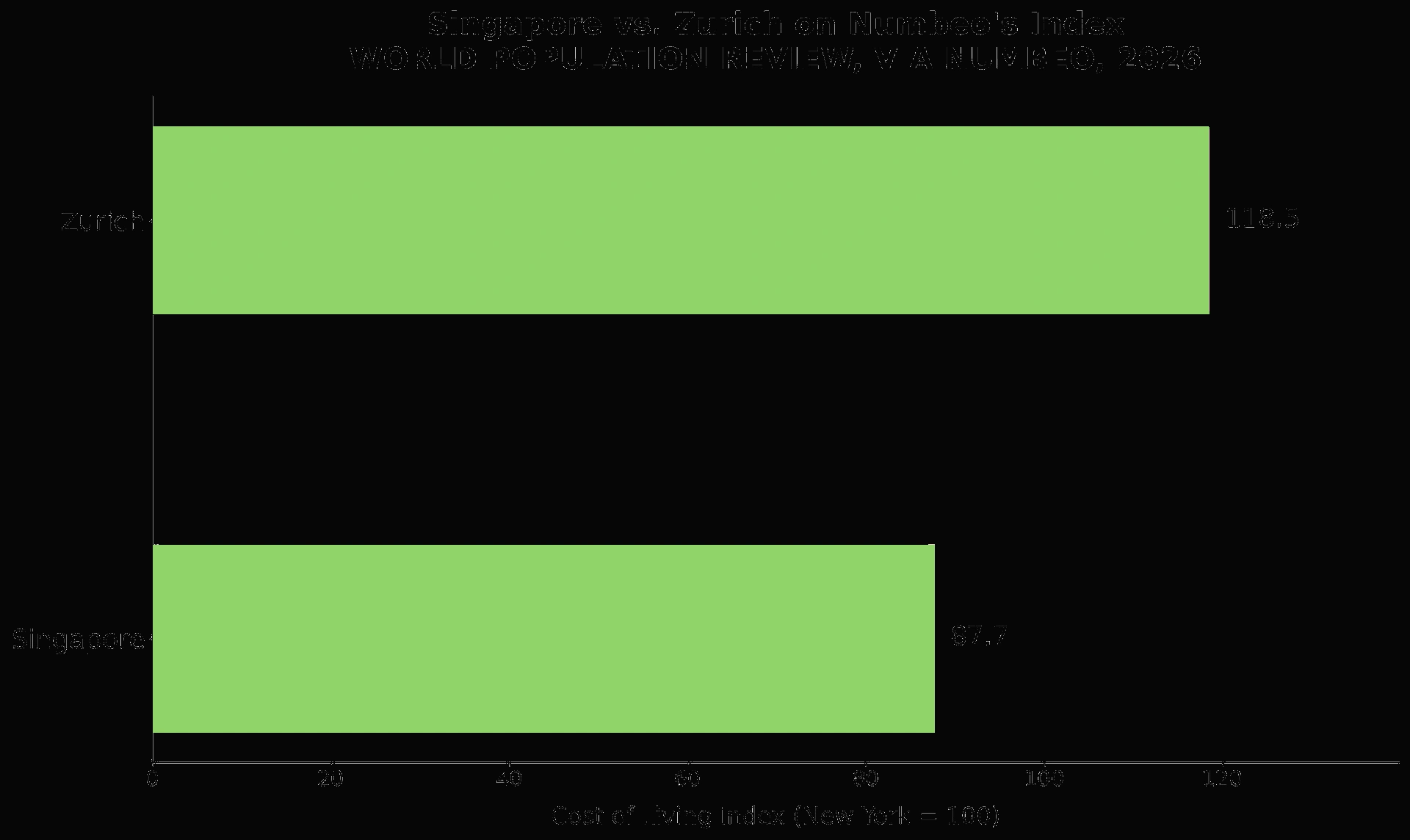
Both indexes convert local prices to US dollars, meaning currency fluctuations can alter a city's ranking even if local prices remain stable. For instance, Singapore and Zurich jointly topped the EIU's most recent Worldwide Cost of Living ranking, despite Singapore scoring 87.7 against Zurich's 118.5 on Numbeo's city index in the same year. This highlights that no single ranking provides a definitive answer; each offers a specific lens.
Factors contributing to high costs vary:
- Singapore: High dependence on imports (roughly 90% of its food) and significant car ownership costs. A Volkswagen Golf, for example, costs over $78,000 in Singapore compared to about $20,000 in the US.
- Norway: Posts a high Numbeo Cost of Living Plus Rent score of 69.0, exceeding the United States' 64.9. However, Norway also features correspondingly high wages and smaller income disparities, alongside free universal healthcare and tuition-free higher education, funded by a tax-to-GDP ratio of 40.2% (compared to the US figure of 25.6%).
- Hong Kong: Consistently ranks as the world's most expensive housing market due to extreme population density and limited developable land. An individual earning $50,000 annually might face a typical home cost of approximately $900,000, eighteen times their income. The government's control over land sales at premium prices funds Hong Kong's unusually low income taxes.
The World's Most Affordable Countries
At the opposite end of the spectrum, several countries offer dramatically lower living costs. Pakistan holds the world's lowest Numbeo cost-of-living index at 18.6, making it more than 80% cheaper than New York City. Egypt and Nepal also rank among the cheapest, where comfortable monthly budgets can range from $400 to $600. Egypt, in particular, offers the highest overall quality of life within this group of highly affordable nations.
These countries are predominantly located in South Asia, the Middle East, or Africa, regions characterized by lower wages that align with the reduced cost of living. The disparity between the world's cheapest and most expensive countries spans more than eightfold when measured on a consistent US-dollar scale, underscoring the vast global differences in economic conditions and purchasing power.
Key takeaways
- Bermuda leads as the most expensive country globally, driven by its island geography and tax haven status.
- Switzerland dominates city-level rankings, with Zurich and Geneva consistently at the top, partly due to high food prices.
- Cost of living indexes vary significantly based on methodology (crowdsourcing vs. researcher surveys) and currency conversion impacts.
- High costs in places like Norway and Hong Kong are often balanced by high wages, comprehensive social services, or unique tax structures.
- Pakistan, Egypt, and Nepal offer the world's lowest living costs, primarily found in South Asia, the Middle East, and Africa.
Disclaimer: This article provides general information based on World Population Review data and should not be considered financial, legal, or tax advice. Cost of living figures are dynamic and subject to change.
Compare jurisdictions with TERRA AI
Statistics about where people live are only half the decision. If you are building an online business or choosing tax residency deliberately, TERRA AI compares Stacks by tax treatment, regulatory burden, sovereignty, and values — then connects you with licensed attorneys and advisors who execute.
This article is general information only and is not legal or tax advice. Consult a licensed professional in your jurisdiction before acting on residency, incorporation, or tax topics.