 Shadow
 National Pride Rankings: Who Loves Their Country Most?
A global survey reveals 94% of people in Morocco and Fiji are willing to fight for their country, while only 11% in Japan say the same.
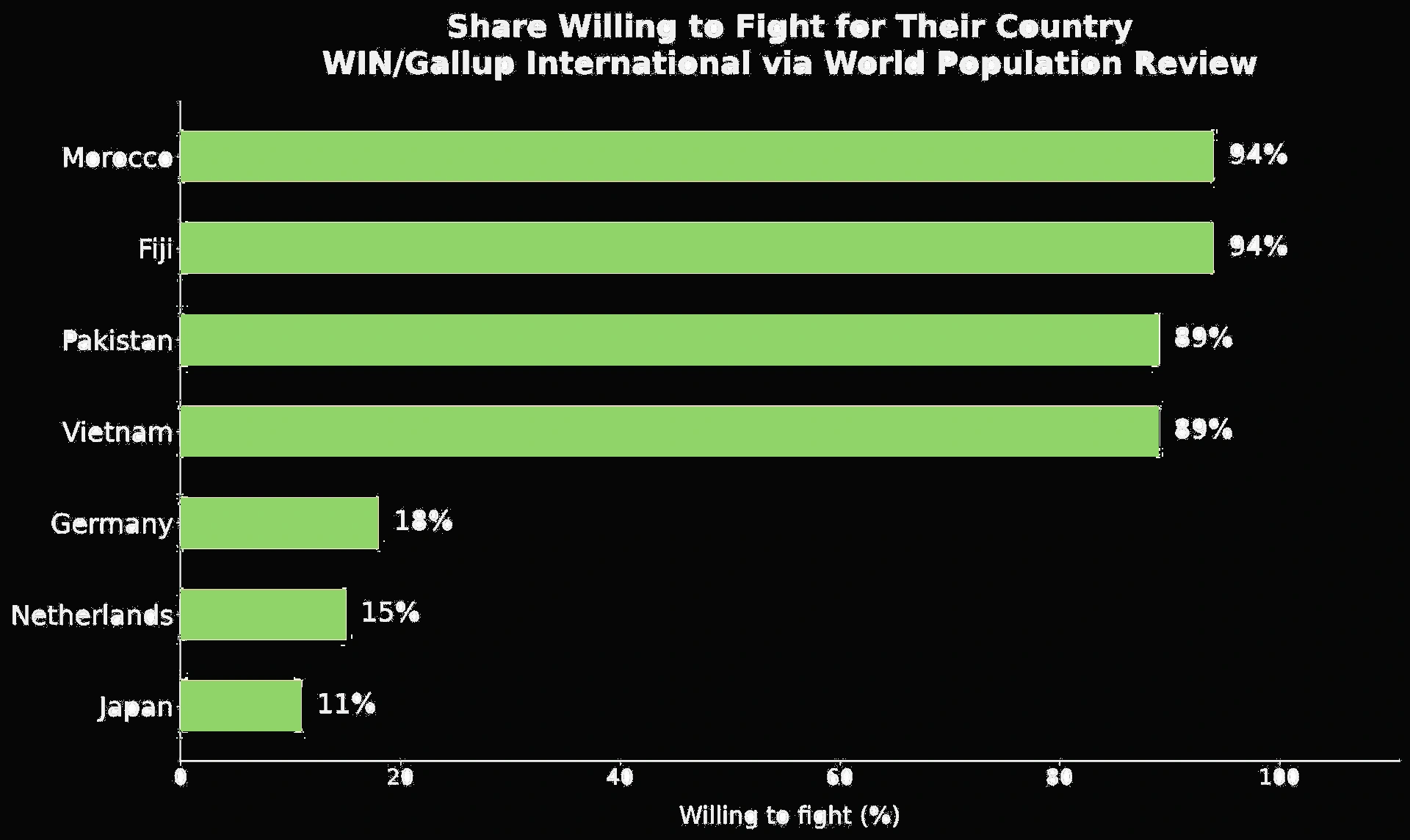
National pride is a fundamental force shaping public life, influencing everything from civic participation to willingness to defend one's nation. Recent data compiled by World Population Review, based on WIN/Gallup International and Pew Research Center surveys, reveals significant global disparities in how deeply this pride runs and what specifically ignites it. Morocco and Fiji lead the world with 94% of their populations expressing a willingness to fight for their country.
Global Willingness to Fight for One's Nation
One of the most direct measures of patriotism is the willingness of citizens to take up arms for their country. A WIN/Gallup International survey, analyzed by World Population Review, highlights a stark global contrast in this sentiment.
- Morocco and Fiji stand out, with 94% of their populations indicating they would be willing to fight for their nation.
- Pakistan and Vietnam follow closely, both reporting 89% willingness.
At the other end of the spectrum, some developed nations show significantly lower figures:
- Only 11% of people in Japan expressed a willingness to fight.
- The Netherlands reported 15%, and Germany 18%.
This wide disparity, exceeding 80 percentage points between the highest and lowest figures, underscores fundamental differences in national identity and perceived threats across the globe.
Shifting National Pride in the United States
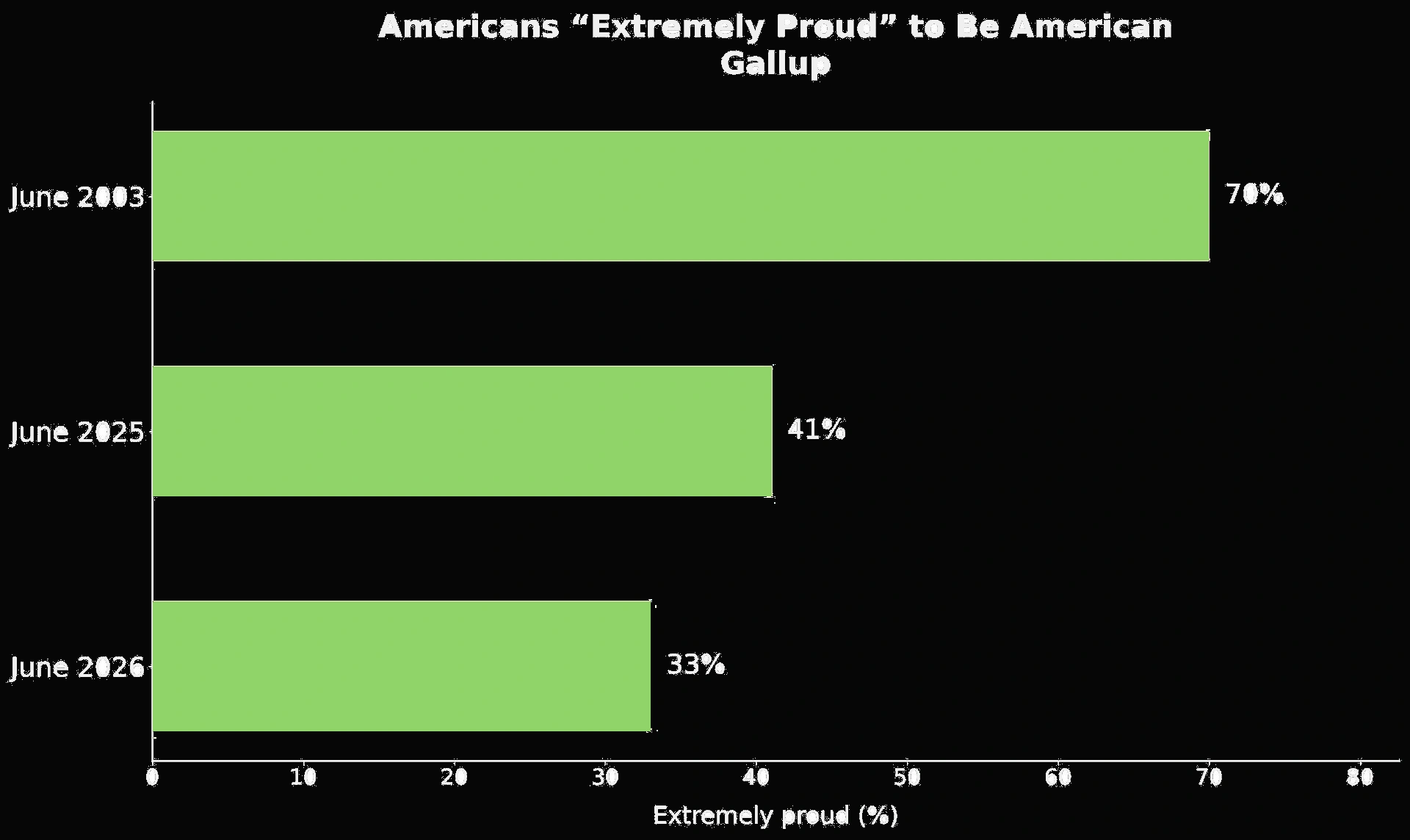
In the United States, national pride has reached its lowest point in Gallup's historical records. Data from June 2023 shows a significant decline in the number of Americans who identify as "extremely proud" to be American.
- Only 33% of Americans now say they are "extremely proud," a drop from 41% just a year prior.
- This figure is less than half the 70% recorded in June 2003.
The decline in pride is not uniform, showing sharp divisions along political and generational lines:
| Group | Extremely Proud |
|---|---|
| Republicans | 70% |
| Independents | 28% |
| Democrats | 14% |
| Aged 18-34 | 14% |
| Aged 55 and older | 48% |
These figures indicate that while overall pride has decreased, it remains strong within certain demographics, particularly among older Americans and Republicans. The data suggests a fragmentation of national pride rather than its complete disappearance.
Canadian Pride: Naturalized Citizens Lead the Way
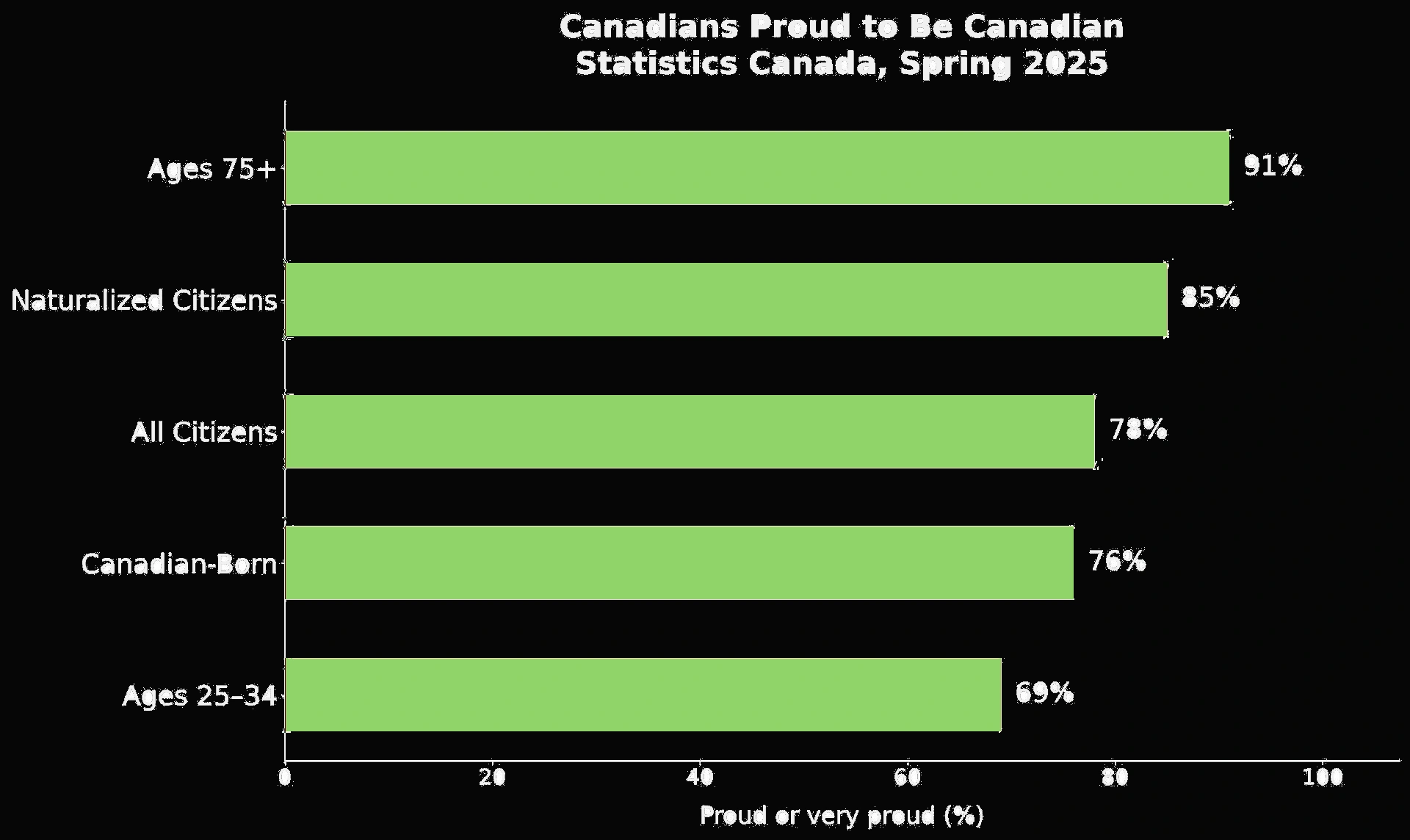
North of the border, Canada presents a contrasting narrative, with national pride trending upwards. In spring 2025, a significant majority of Canadian citizens expressed pride in their country.
- 78% of Canadian citizens reported being proud or very proud to be Canadian, an increase from 74% in fall 2024.
- Naturalized citizens demonstrated the highest levels of pride at 85%, compared to 76% of those born Canadian.
Generational shifts are also evident, with a notable increase in pride among younger adults:
- Adults aged 25 to 34 saw the biggest jump, with their pride rising nine points, though they remain the least proud age group at 69%.
- Canadians aged 75 and older were the proudest overall, at 91%.
This data suggests that for Canada, the act of choosing the country through naturalization often correlates with a stronger sense of national pride.
Diverse Sources of National Pride Across Countries
A 2025 Pew Research Center survey, encompassing over 33,000 people in 25 countries, explored what specifically makes citizens proud of their nation. The answers reveal a wide array of values and priorities:
- In Sweden, 53% cited the country's political system as their primary source of pride, the highest share for any single answer globally.
- For Japan, 41% named the Japanese people themselves.
- Greece's pride is rooted in its history (37%), while Germany also pointed to its political system (36%).
- In Argentina, the people were the main source of pride (35%), and in Indonesia, 30% named the country's diversity.
These varied responses highlight that national pride is not monolithic; it reflects what each nation collectively values most, whether it's institutions, heritage, or its populace.
Negative Sentiments and Cultural Identity as Pride Points
While many countries express pride in positive attributes, a striking share of people in some European nations responded with negative feelings when asked about their national pride.
- In the United Kingdom, 29% gave a negative response, making it the most common answer.
- Spain followed with 25% negative responses, and Hungary with 23%.
- Even in Greece, where history is a major source of pride, 19% responded negatively.
Conversely, in other parts of the world, negative responses were almost negligible:
- Only 2% of Indonesians and 3% of Indians gave a negative answer.
- Argentina and Sweden reported 6%, Turkey 7%, and Japan 8%.
- The United States saw 20% negative responses, and Nigeria 25%.
Beyond politics and history, culture, arts, and lifestyle also serve as significant sources of national pride:
- Italy leads in cultural pride, with 38% naming arts and culture.
- Mexico followed at 30%, and France at 26%.
- For lifestyle, Spain (14%) and Australia (13%) stood out.
These cultural elements often represent a shared way of life that transcends political divisions, forming a resilient foundation for national identity.
Key takeaways
- Willingness to fight for one's country varies dramatically, from 94% in Morocco and Fiji to 11% in Japan.
- National pride in the United States has declined significantly, reaching 33% for "extremely proud" Americans, with sharp divides by political party and age.
- Canadian pride is on the rise, with naturalized citizens (85%) showing higher levels of pride than those born in Canada (76%).
- Sources of national pride are diverse, ranging from political systems (Sweden, 53%) and people (Japan, 41%) to history (Greece, 37%) and diversity (Indonesia, 30%).
- Negative sentiments about national pride are more common in some European countries like the UK (29%) and Spain (25%), while almost absent in nations like Indonesia (2%) and India (3%).
- Culture, arts, and lifestyle are significant pride points in countries like Italy (38%), Mexico (30%), and Spain (14%).
Disclaimer: This article provides general information based on public surveys and is not intended as legal, tax, or financial advice. National pride and identity are complex and multifaceted concepts.
Compare jurisdictions with TERRA AI
Statistics about where people live are only half the decision. If you are building an online business or choosing tax residency deliberately, TERRA AI compares Stacks by tax treatment, regulatory burden, sovereignty, and values — then connects you with licensed attorneys and advisors who execute.
This article is general information only and is not legal or tax advice. Consult a licensed professional in your jurisdiction before acting on residency, incorporation, or tax topics.