 Shadow
 Where People Are Most Punctual: Global Rankings
Japan's bullet trains average just 1.6 minutes of delay, making it a global leader in punctuality. Discover which countries and carriers excel at keeping schedules.

Punctuality varies significantly across the globe, with some nations integrating precise timing into their daily infrastructure while others embrace a more flexible approach. Japan stands out as a global benchmark, where its busiest bullet train line, the Tokaido Shinkansen, maintains an average delay of just 1.6 minutes per train, even accounting for natural disruptions.
Japan's Unmatched Rail Precision
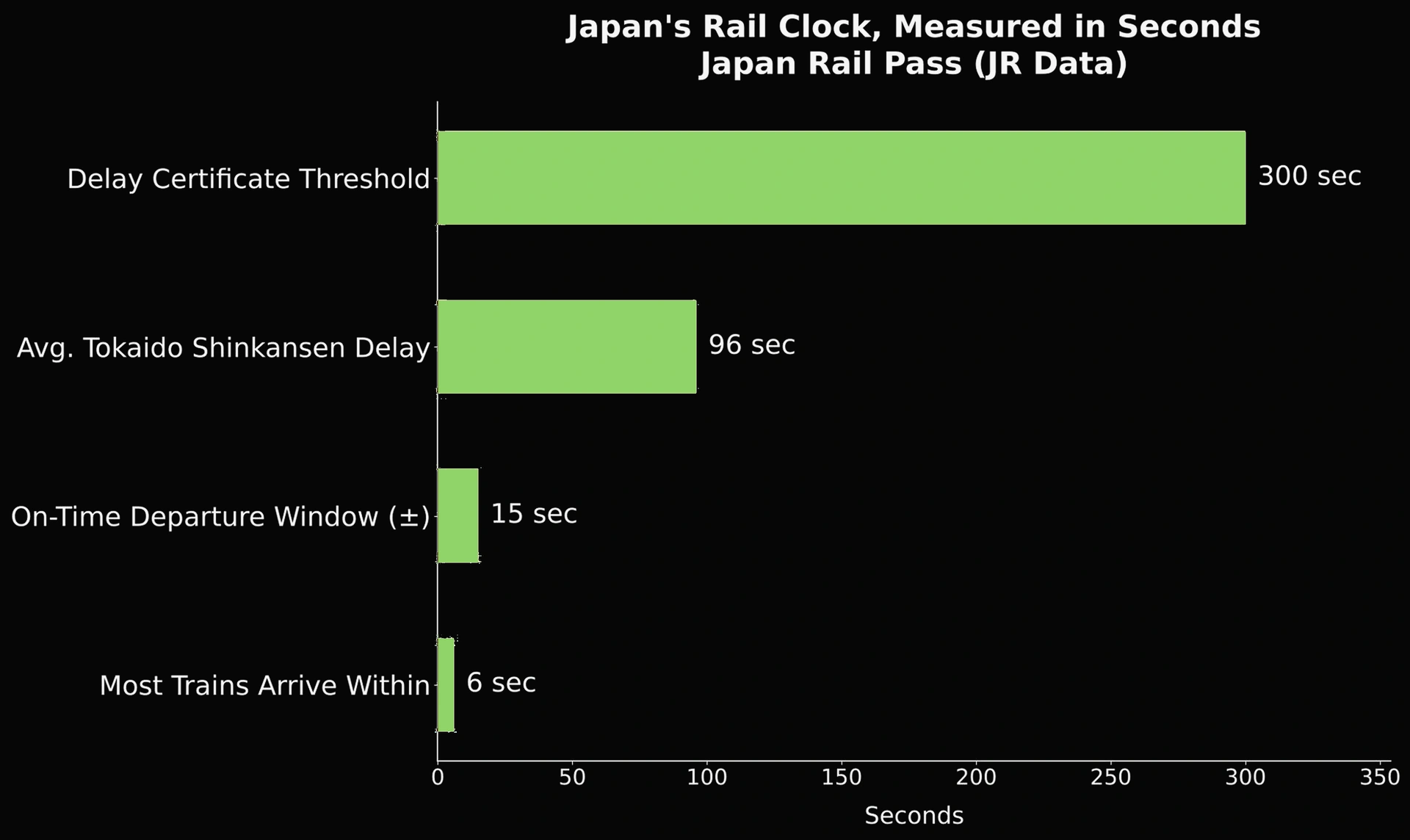
Japan has elevated punctuality to an art form, particularly within its extensive railway network. The Tokaido Shinkansen, the nation's busiest bullet train line, exemplifies this commitment, with an average delay of only 1.6 minutes per train. This figure includes delays caused by unforeseen events like natural disasters, highlighting the system's robust design and operational efficiency.
The standard for 'on time' in Japan's rail system is exceptionally strict: a train is considered punctual only if it departs within 15 seconds of its scheduled time. Most trains achieve an even higher standard, arriving within 6 seconds of their scheduled arrival. When a train experiences a delay of just five minutes, rail companies issue official delay certificates, which passengers can present to employers or schools as proof.
- Japan's train system ranks first globally for reliability, scoring 6.8 out of 7.
- The average delay on the Tokaido Shinkansen is 1.6 minutes, even with natural disasters.
- Trains must depart within 15 seconds of schedule to be considered on time.
- Most trains arrive within 6 seconds of their scheduled time.
- Five-minute delays warrant official certificates for passengers.
European Train Punctuality: A Continental Divide
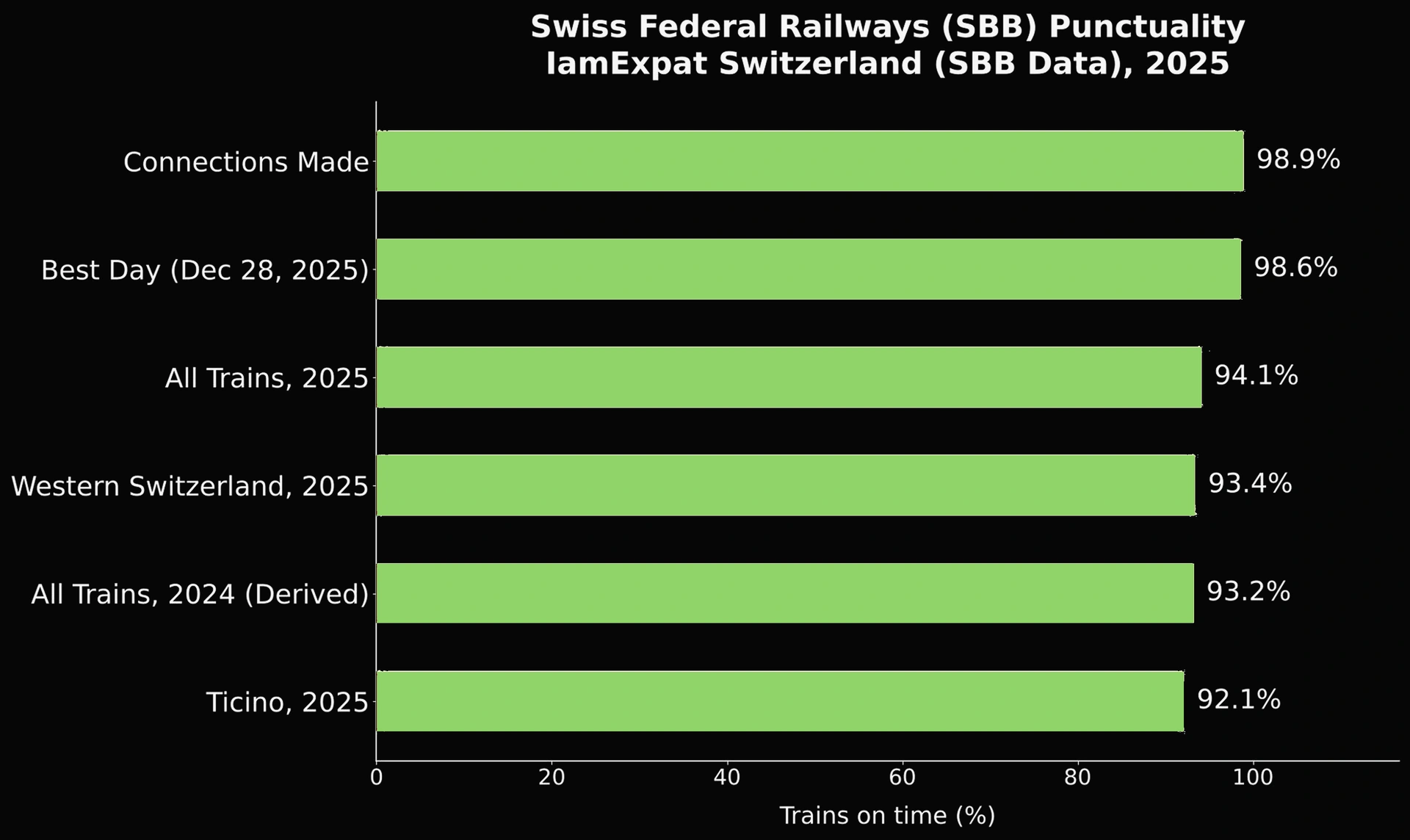
Across Europe, train punctuality varies significantly by country. Switzerland consistently demonstrates high performance, with 94.1% of Swiss Federal Railways (SBB) trains reaching their destination on time in 2025—a record high. This marked a 0.9 percentage point improvement over the previous year. Furthermore, 98.9% of passenger connections between trains operated as planned, ensuring seamless travel.
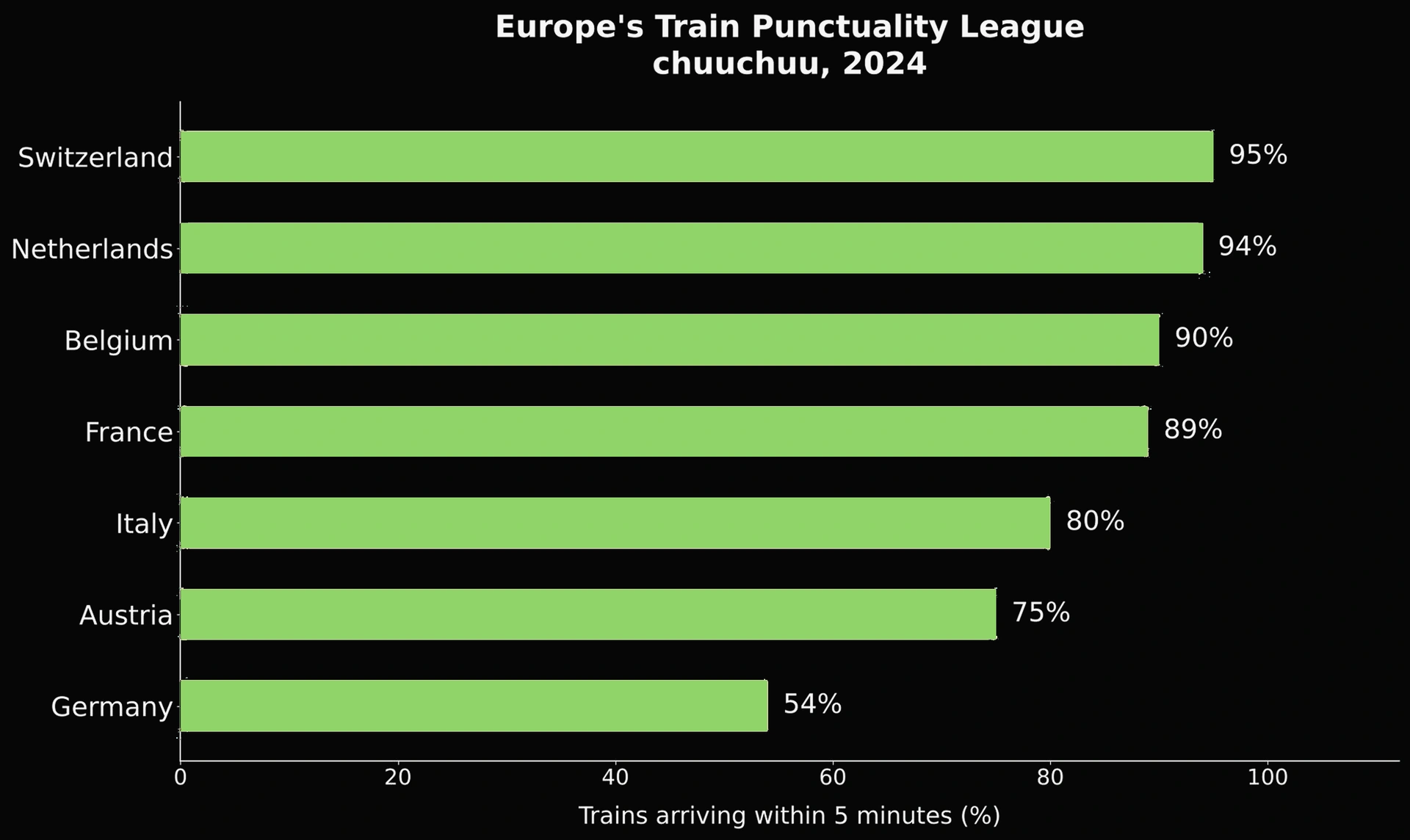
While Switzerland leads, other European nations show a broader range of performance. According to 2024 data, Switzerland recorded 95% of trains arriving within five minutes of schedule. The Netherlands followed closely at 94%, with Belgium at 90% and France at 89%. Italy and Austria reported lower rates, at 80% and 75% respectively.
Germany, despite its reputation for efficiency, recorded the lowest punctuality among these nations, with just 54% of its trains arriving on time. In 2025, Deutsche Bahn's long-distance trains achieved only 60.1% punctuality, marking its worst result on record. In October 2025, this figure plummeted to 48.5%, meaning more than half of long-distance trains were late that month. Regional and S-Bahn trains in Germany performed better, at around 90%.
| Country | Train Punctuality (within 5 mins) |
|---|---|
| Switzerland | 95% |
| Netherlands | 94% |
| Belgium | 90% |
| France | 89% |
| Italy | 80% |
| Austria | 75% |
| Germany | 54% |
Global Airlines Setting the Standard for On-Time Performance
In air travel, punctuality leaders emerge from diverse regions. Aeromexico was recognized as the world’s most on-time global airline in 2025, with 90.02% of its flights arriving on schedule, according to aviation analytics firm Cirium. This marked a repeat performance as the top airline globally.
Regional carriers also demonstrated strong punctuality. South Africa’s Safair achieved the highest rate among regional leaders at 91.06%, followed by Latin America’s Copa Airlines at 90.75%. In Europe, Iberia Express led with 88.94% on-time flights, while Philippine Airlines topped the Asia-Pacific region at 83.12%. In North America, Delta Air Lines recorded an 80.90% on-time performance.
These figures indicate a shift in global aviation, with Latin American and African carriers increasingly rivaling and often surpassing the punctuality of many well-established airlines worldwide.
Airports Leading the World in Punctual Departures
Latin American airports notably dominate the global punctuality rankings. Santiago, Chile, was the world’s most punctual large airport in 2025, with 87.04% of flights departing on time. Riyadh, Saudi Arabia, followed at 86.81%, with Mexico City at 86.55% and Honolulu, United States, at 86.51%.
In the medium-sized airport category, Panama City’s Tocumen airport achieved the highest rate globally at 93.34%. Guayaquil, Ecuador, led the small-airport rankings for the second consecutive year, with an impressive 91.47% on-time departure rate. This consistent performance underscores Latin America's strong showing across all airport size categories.
The Cultural Spectrum of Lateness
Even in highly punctual nations like Switzerland, the definition of 'on time' can be subjective. A survey of nearly 8,000 Swiss adults revealed varying tolerances for lateness. While 15% considered any delay unacceptable, 33% found a five-minute delay acceptable, and 51% would tolerate ten minutes or more.
Cultural and demographic factors also play a role. Among Swiss residents, 23% of Italian speakers and 21% of French speakers reported zero tolerance for lateness, compared to just 13% of German speakers. Age also influenced perceptions, with 23% of individuals over 65 viewing any lateness as impolite, contrasting with 12% of those aged 18 to 34.
These insights highlight that punctuality is not merely about efficient systems but also deeply intertwined with cultural norms and individual expectations. For founders considering international operations or relocation, understanding these nuances can be as critical as evaluating logistical performance.
Key takeaways
- Japan's rail system sets a global standard for punctuality, with minimal delays and strict adherence to schedules.
- European train punctuality varies widely, with Switzerland leading at 95% on-time arrivals, while Germany lags significantly at 54%.
- Latin American airlines and airports, such as Aeromexico and Santiago, Chile, are emerging as global leaders in on-time performance.
- Even in highly punctual countries like Switzerland, cultural and demographic factors influence individual perceptions of what constitutes 'late.'
- Punctuality is a complex interplay of robust infrastructure, operational efficiency, and deeply ingrained cultural expectations.
Disclaimer: This article provides general information based on publicly available data and does not constitute professional advice. Punctuality statistics can vary based on reporting methodologies and timeframes.
Compare jurisdictions with TERRA AI
Statistics about where people live are only half the decision. If you are building an online business or choosing tax residency deliberately, TERRA AI compares Stacks by tax treatment, regulatory burden, sovereignty, and values — then connects you with licensed attorneys and advisors who execute.
This article is general information only and is not legal or tax advice. Consult a licensed professional in your jurisdiction before acting on residency, incorporation, or tax topics.