 Shadow
 Why China Has Ten Times Fewer Left-Handers Than the Netherlands
A global study of over 400,000 people reveals the Netherlands leads with 12.95% left-handers, while China reports just 2.64%, less than a quarter of the 10.6% global average.

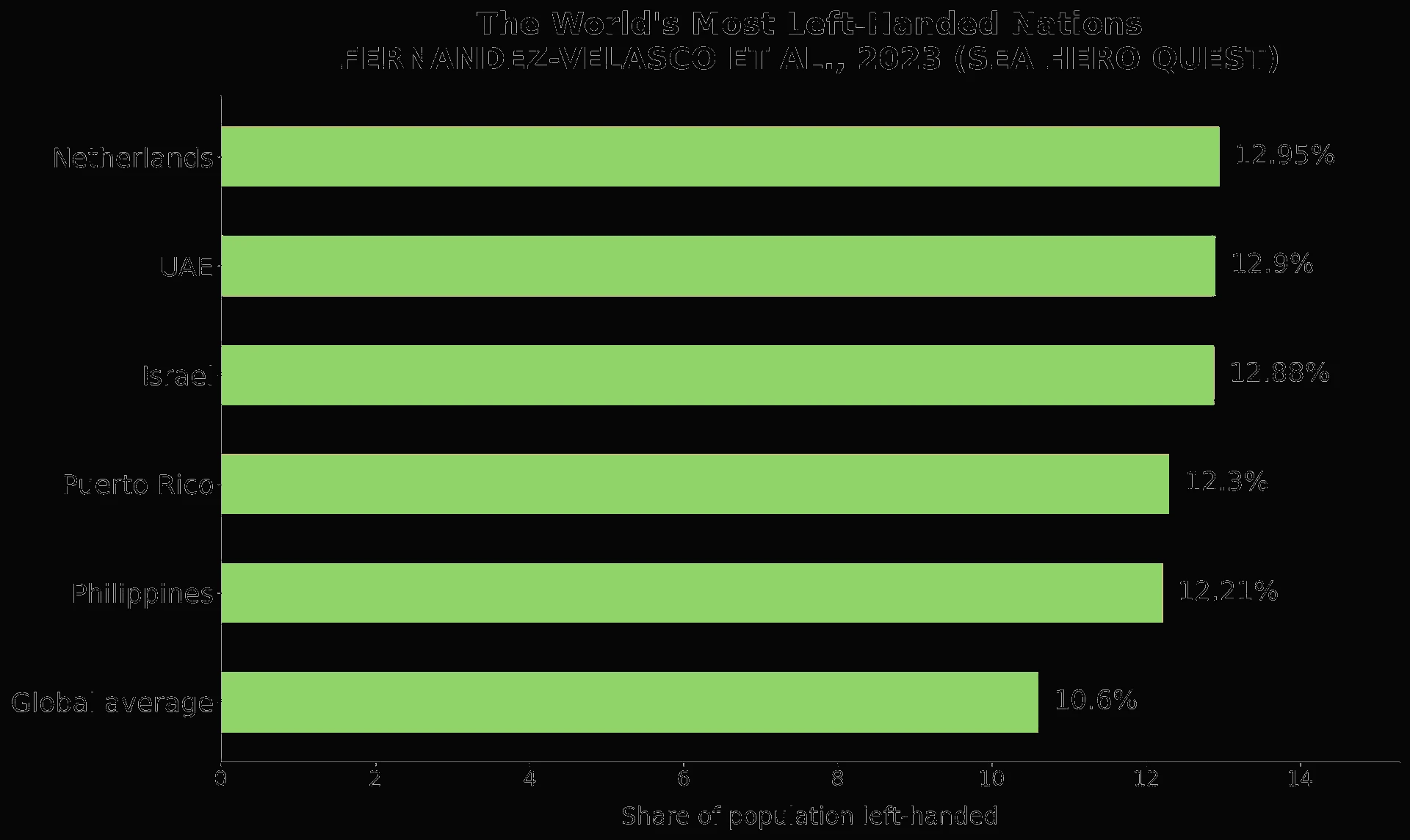
The Netherlands leads the world in reported left-handedness, with 12.95% of its population identifying as left-handed. In stark contrast, China reports a rate of just 2.64%, illustrating a significant global disparity that is more cultural than biological.
Global Disparities in Left-Handedness Rates
Left-handedness is a stable trait within an individual's lifetime, yet its reported prevalence varies dramatically across countries and generations. A comprehensive global survey, analyzing data from over 400,000 participants in 41 countries through the Sea Hero Quest mobile navigation game, has mapped these variations.
The study identified the Netherlands as the country with the highest proportion of left-handers, at 12.95%. This figure places it notably above the study's global average of 10.6%.
The top five nations for left-handedness demonstrate a diverse geographical spread, indicating that high rates are not confined to any single region:
- Netherlands: 12.95%
- United Arab Emirates: 12.90%
- Israel: 12.88%
- Puerto Rico: 12.30%
- Philippines: 12.21%
The United States reported a rate close to the global average, with 10.9% of its population being left-handed. This translates to approximately 36 million left-handed Americans, based on the country's population.
Asia's Lowest Reported Left-Handedness
In stark contrast to the global leaders, the lowest rates of left-handedness are predominantly found in Asia. China recorded the lowest rate in the study, with only 2.64% of its population identifying as left-handed. This figure is less than a quarter of the global average and nearly five times lower than the Netherlands.
The five countries with the lowest reported left-handedness rates are all located in Asia:
- China: 2.64%
- Indonesia: 3.39%
- Vietnam: 4.26%
- Hong Kong: 4.85%
- Taiwan: 5.16%
Researchers attribute these low rates to strong cultural pressures towards conformity and decades of rapid industrialization. These factors often led to the practice of training naturally left-handed children to use their right hand, a practice that has significantly influenced reported handedness across generations in these regions.

Generational Shifts and Cultural Influence
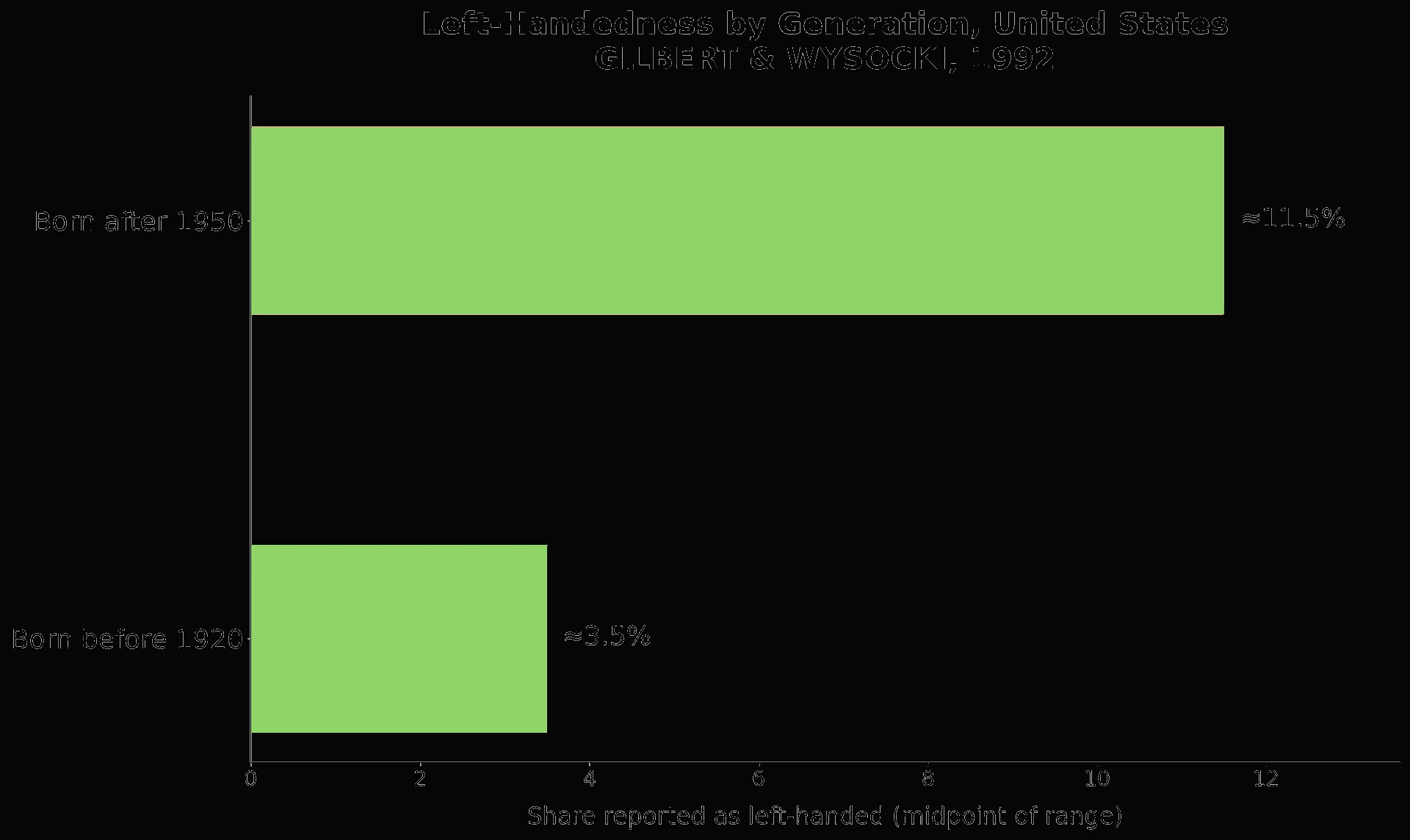
While an individual's handedness remains constant, the overall reported rates have changed dramatically over time. A landmark 1992 survey of over 1.1 million Americans revealed a threefold increase in left-handedness across generations. Only 3% to 4% of individuals born before 1920 were recorded as left-handed, compared to 11% to 12% of those born after 1950.
Further analysis from a separate study showed left-handedness at 15.22% among 21- to 30-year-olds, dropping to 1.67% in individuals over 80. This trend is accompanied by a corresponding rise in people who reported switching their writing hand, from 2.69% in younger groups to 6.75% in older demographics. This suggests that the decline in left-handedness among older populations is not due to lefties dying off, but rather a historical practice of training naturally left-handed children to write with their right hand, a practice that largely faded during the twentieth century.
Left-handedness also shows a consistent gender split. Large-scale studies indicate that approximately 13% of men are left-handed, compared to 11% of women. This ratio of about five left-handed men for every four left-handed women has remained remarkably constant across all generations studied, even as the overall rate of left-handedness has increased.
Biological Factors and Athletic Advantages
Research into handedness also explores biological underpinnings and specific advantages. Twins, for instance, are more likely to be left-handed than singletons. A meta-analysis found that identical twins, sharing 100% of their DNA, exhibit almost the same rate of left-handedness as fraternal twins, who share 50%. The UK Biobank's sample of 500,000 individuals reported 9.5% left-handed singletons compared to 11.2% for twins and other multiples. This suggests that the "twin effect" is primarily linked to the physical stresses of a shared womb and birth, such as lower birth weight, rather than genetics, which account for only about 21% of handedness heritability.
In certain competitive sports, left-handers demonstrate a distinct advantage, particularly in fast, face-to-face, one-on-one contests. Examples include:
- Table Tennis: Between 18.64% (female) and 25.18% (male) of top-200 world-ranked players are left-handed.
- Fencing (épée and foil): The figure reaches as high as 25.75% among top male competitors.
- Professional Boxing: In 2019, 17.00% of men and 12.50% of women fought in the left-handed "southpaw" stance.
This advantage, termed the negative frequency-dependent advantage by scientists, arises because opponents have less practice against a left-handed style due to its rarity. This edge is less apparent in sports like tennis, squash, or throwing events, where opponents have more time to adjust during play.
It is important to note that the widely circulated claim that left-handed people die nine years younger than right-handers has been debunked. This claim originated from a flawed 1991 study that compared average ages of death in a single year, failing to account for the generational increase in left-handedness. Subsequent studies, including one on Danish twins and another tracking 5,500 cricketers, found no significant mortality difference between left- and right-handed individuals.
Key takeaways
- The prevalence of left-handedness varies significantly globally, with the Netherlands reporting the highest rate (12.95%) and China the lowest (2.64%).
- Cultural pressures and historical practices of training children to write right-handed are primary drivers of these disparities, particularly in Asian countries.
- Reported rates of left-handedness have nearly quadrupled over the last century, reflecting a decline in cultural suppression rather than a biological shift.
- Left-handedness is more common in men than women, a ratio that has remained consistent despite overall rate changes.
- Left-handers often exhibit an athletic advantage in fast, one-on-one sports due to the rarity of their style, providing opponents less practice against it.
This article provides general information and statistics for informational purposes only and does not constitute professional advice. Consult with qualified experts for specific guidance.
Compare jurisdictions with TERRA AI
Statistics about where people live are only half the decision. If you are building an online business or choosing tax residency deliberately, TERRA AI compares Stacks by tax treatment, regulatory burden, sovereignty, and values — then connects you with licensed attorneys and advisors who execute.
This article is general information only and is not legal or tax advice. Consult a licensed professional in your jurisdiction before acting on residency, incorporation, or tax topics.