 Shadow
 Why So Many Homes Sit Empty, and Where It Happens Most
Despite widespread housing shortages, millions of homes globally sit vacant. China leads with an estimated 65 million empty homes, while Bulgaria has the highest proportion at 38.9% of its housing units uninhabited.
Across the globe, millions of homes remain vacant even as housing shortages dominate headlines. This paradox is evident in nearly every developed nation, with the scale of empty properties often exceeding public perception. Understanding where these homes are and the forces behind their vacancy reveals a complex picture of economic, demographic, and social factors.
The Global Landscape of Vacant Housing
The phenomenon of vacant housing is not uniform; its causes and scale vary significantly by country. While some nations grapple with the sheer volume of unused properties, others face high vacancy rates relative to their total housing stock. This data-driven analysis explores the leading countries by both raw count and proportion, offering insights into the underlying dynamics.
The Biggest Piles of Empty Homes Are Enormous
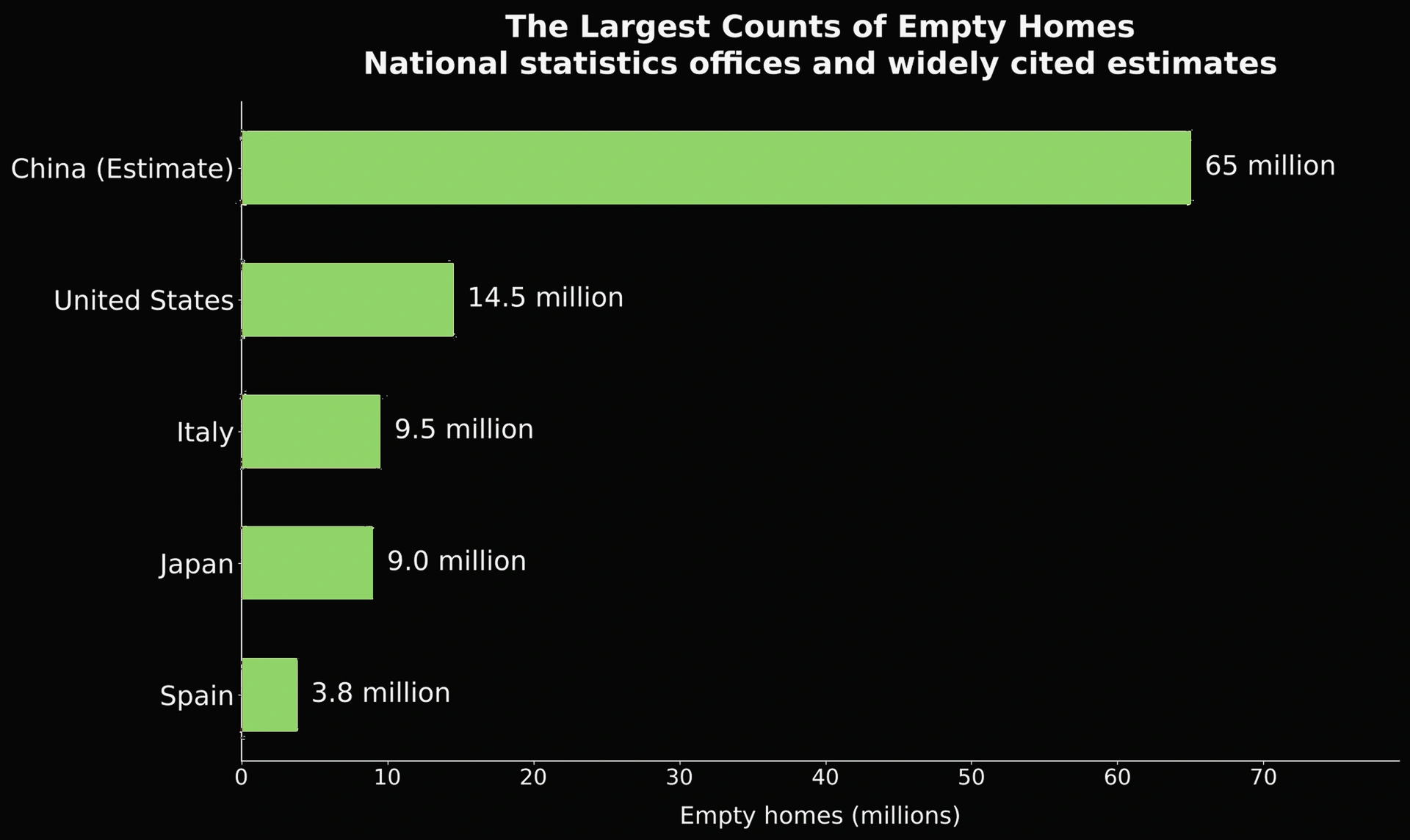
When measured by sheer volume, a few countries hold staggering numbers of empty housing units. These figures highlight the immense scale of unused residential capacity in some of the world's largest economies.
- China: Widely estimated to have around 65 million empty homes, this figure is by far the largest globally.
- United States: Follows with approximately 14.5 million vacant properties.
- Italy: Reports about 9.5 million empty homes.
- Japan: Counts 9.0 million vacant houses.
- Spain: Rounds out this group with 3.8 million empty homes.
China's estimate alone is more than four times the American count and significantly larger than the combined totals for Italy and Japan. The four countries behind China collectively account for about 37 million empty homes, which is roughly 28 million fewer than China's estimated total on its own.
Inside Japan’s Nine Million Empty Houses
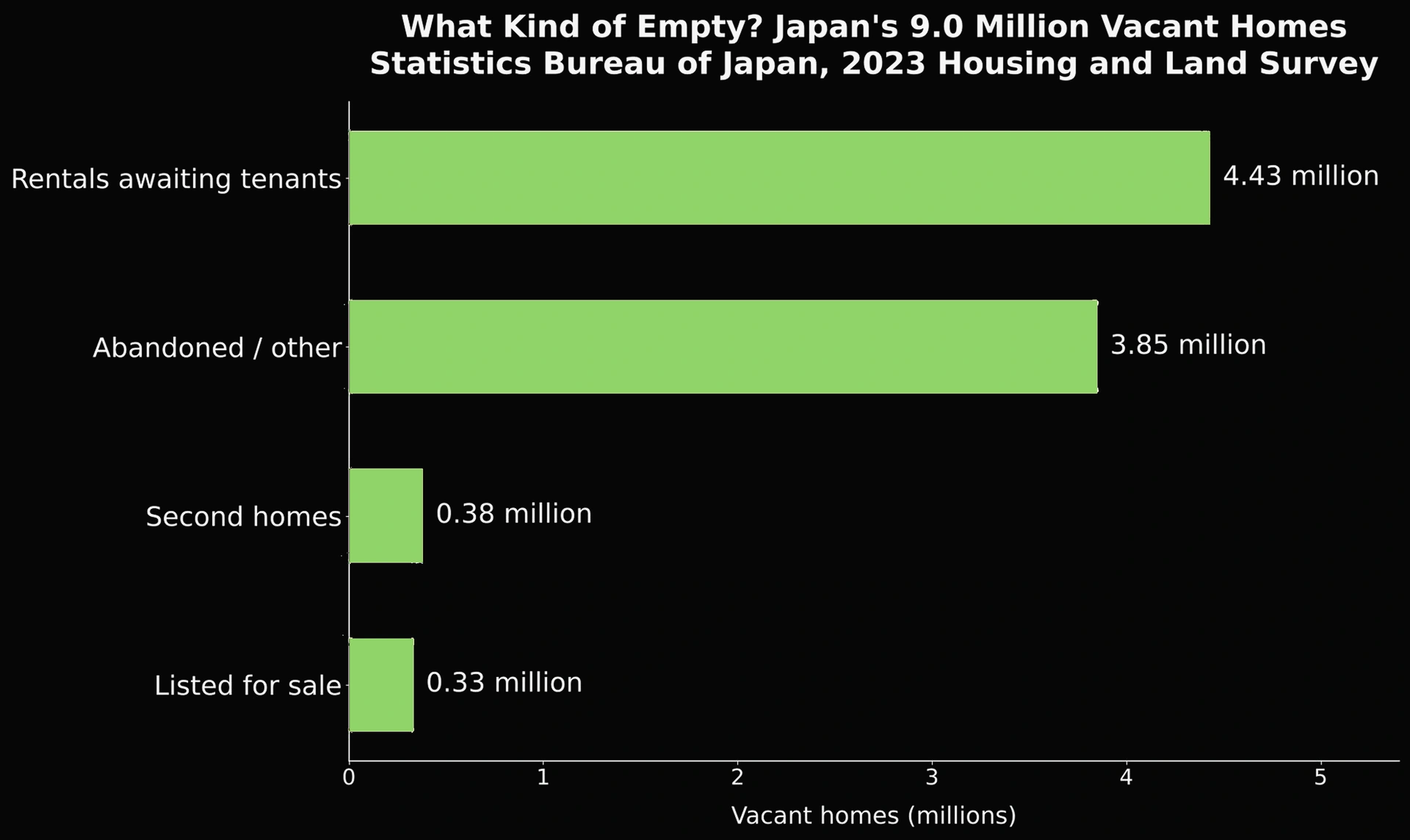
Japan's latest national housing survey identified a record 9.0 million vacant homes. A closer examination reveals the diverse categories of these empty properties, indicating different underlying issues.
- Rental homes: The largest category, with 4.43 million units awaiting tenants.
- Abandoned/Unclassified: Approximately 3.85 million houses fall into this category, not listed for rent, sale, or as holiday retreats.
- Second homes: Account for a smaller portion, at 0.38 million.
- Homes for sale: Represent only 0.33 million of the total.
This breakdown shows that abandoned houses constitute a far larger segment of Japan's vacant stock than properties actively listed for sale. Over the past three decades, the overall count of empty homes in Japan has roughly doubled. More than 40% of Japan’s empty homes are in the abandoned category, effectively outside any market activity.
When Over One-Third of Homes Has No One Home
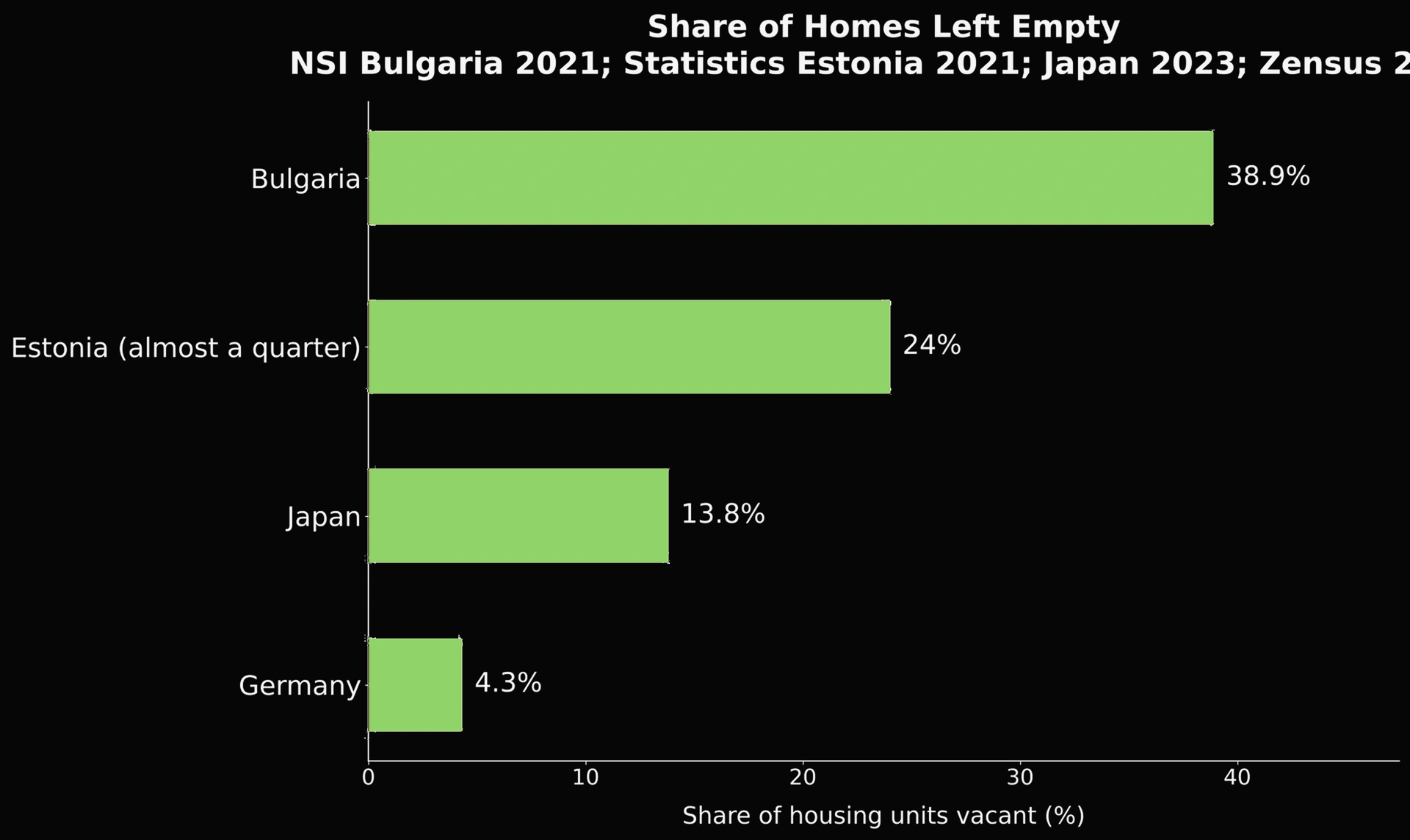
While raw counts highlight the scale in large countries, vacancy rates — the proportion of uninhabited housing units — tell a different story, often revealing leaders that are not major economies.
- Bulgaria: Tops the list with 38.9% of its housing units uninhabited as of the 2021 census.
- Estonia: Reports almost a quarter of its dwellings as vacant.
- Japan: Stands at 13.8%, meaning roughly one in seven homes is empty.
Bulgaria's vacancy share is approximately nine times that of Germany and nearly three times Japan's. This indicates that in Bulgaria, the likelihood of encountering an empty home on any given street is significantly higher than in many other nations. A country can have a modest total count of empty homes yet still be one of the emptiest places on Earth when considering its housing stock size.
Countries with Over a Million Empty Homes
Beyond the nations with the largest overall counts, a second tier of countries each report more than a million vacant homes, reflecting diverse regional challenges.
- South Korea: Counted 1.53 million empty homes in 2023, influenced by an aging population and urban migration. The government has initiated efforts to repurpose abandoned properties.
- Canada: Has approximately 1.3 million vacant homes, according to OECD figures.
- Poland: Reports over one million empty homes, as per Polish research.
Even some of Western Europe's largest economies, despite lower vacancy rates, contribute significantly to the global total of empty homes. France, for instance, has more than 3 million vacant homes, a figure that has risen by roughly 60% since 1990. Germany, with a 4.3% vacancy rate, still accounts for nearly two million empty homes. Australia also reports over one million vacant properties. These numbers underscore that vacancy and housing shortages can coexist within the same market, even in areas with strong housing demand.
Portugal’s Empty Homes Are Mostly Livable
Portugal provides a detailed perspective on the condition of vacant homes, revealing that many are ready for immediate occupancy. The 2021 census identified 723,000 vacant homes across the country.
Of these, nearly 250,000 are in good condition, meaning roughly one in three could house people without requiring major renovations. This substantial pool of ready-to-use housing sits unused in a country where affordability is a significant public concern. Portuguese housing data illustrate a country of extremes, with some homes overcrowded while others remain vacant.
This pattern is not confined to remote areas. Large concentrations of empty homes are found in and around major metropolitan centers:
- The Attica region, encompassing Athens, has more than 500,000 vacant homes.
- The Lisbon area alone accounts for over 150,000 empty properties.
In both cases, these vacant homes are located in metropolitan areas where demand for housing is highest. A Greek parliamentary study has even linked vacant homes to higher housing prices, demonstrating that empty properties and housing shortages routinely exist side by side, often within the same urban centers. The story of empty homes is less about surplus and more about mismatch, driven by factors ranging from China's sheer scale to Japan's abandoned houses, Bulgaria's high proportion, and Portugal's livable but unused properties.
There is no single, simple answer for why so many homes remain empty, only a growing body of evidence confirming their widespread existence.
Key takeaways
- China has the largest raw count of empty homes globally, estimated at 65 million.
- Bulgaria exhibits the highest proportion of vacant homes, with 38.9% of its housing units uninhabited.
- Japan's 9.0 million vacant homes are largely composed of rental properties and abandoned structures, with over 40% being abandoned.
- Many countries, including South Korea, Canada, and Poland, each have over a million empty homes, reflecting diverse national challenges.
- A significant portion of vacant homes, such as Portugal's 250,000 properties in good condition, are livable and could address housing needs without major renovation.
- Empty homes and housing shortages frequently coexist, even within the same metropolitan areas, indicating a mismatch rather than a surplus.
Disclaimer: This article provides general information based on publicly available data and does not constitute professional advice. Housing markets and regulations are complex and vary by jurisdiction.
Compare jurisdictions with TERRA AI
Statistics about where people live are only half the decision. If you are building an online business or choosing tax residency deliberately, TERRA AI compares Stacks by tax treatment, regulatory burden, sovereignty, and values — then connects you with licensed attorneys and advisors who execute.
This article is general information only and is not legal or tax advice. Consult a licensed professional in your jurisdiction before acting on residency, incorporation, or tax topics.